 Μake us preferred on Google
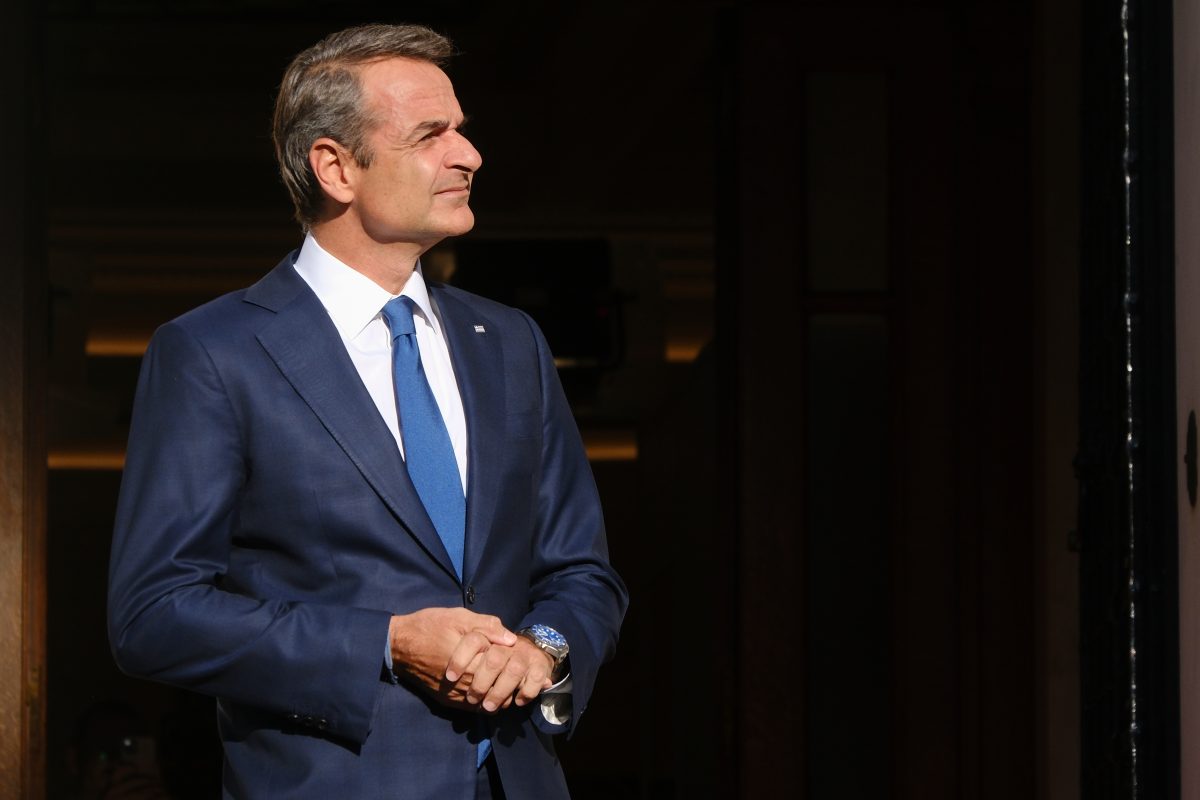
 Greek Prime Minister Kyriakos Mitsotakis returned to his regular Sunday review after a two-week August break, highlighting the response to recent wildfires, the economy and a new €13 billion early repayment of public debt.
He also addressed tensions with Turkey over Greece’s new spatial planning framework for renewable energy, as well as the Greece-Cyprus electricity interconnection, new tourism and renewable energy planning frameworks, water projects in Crete, changes to agricultural subsidies and legislation establishing a “right to be forgotten” for people with a history of cancer.
Wildfires across Greece
Mitsotakis began by addressing the wildfires that have affected Greece in recent weeks, saying they have become a reality facing all of Europe, particularly during the summer.
He reiterated that “climate change does not start fires,” but makes conditions more difficult when fires break out.
According to Mitsotakis, Greece experienced exceptionally strong winds this year. He cited the National Observatory of Athens as saying that the winds remained at very high levels for 20 days, conditions he described as unusual even for the Greek summer.
In areas including Boeotia and Western Attica, conditions at times were so difficult that aerial firefighting aircraft could not operate.
Despite the challenges, Mitsotakis said the area burned in Greece this year was lower both compared with previous years and with other Mediterranean countries.
Since the beginning of August, firefighters and volunteers have responded to more than 500 forest fires, while the total since the start of the fire season has reached 2,700.
At least 1,000 people were evacuated by boats from active fire fronts, Mitsotakis said, while authorities worked to save as many homes and businesses as possible.
He stressed, however, that the deaths caused by the fires “overshadow anything else we can say,” expressing his support for the families of the victims and those whose property was destroyed or threatened.
Inspections of affected areas are continuing so that compensation, benefits and financial assistance can be paid to eligible recipients as quickly as possible.
“We will stand by the people who were affected for as long as necessary,” Mitsotakis said.
Greece to repay another €13 billion in debt early
Turning to the economy, Mitsotakis announced that Greece will make another early repayment of public debt worth €13 billion in 2026.
Together with the €36 billion already repaid ahead of schedule since 2019, he said Greece has recorded the fastest debt reduction in Europe.
Mitsotakis described reducing public debt not as an “abstract concept,” but as a form of “national liberation,” arguing that lower government obligations create greater room to support citizens and improve borrowing conditions for businesses.
He also emphasized intergenerational fairness, saying, “We cannot leave our children with bills that were created in the past.”
The prime minister also referred to the decision by Japanese rating agency R&I to upgrade its outlook for the Greek economy from stable to positive.
He said the agency expects Greece’s economic growth to remain strong in 2026 despite international inflationary pressures and tensions in the Middle East, citing structural reforms and fiscal policy.
Mitsotakis also pointed to the Thessaloniki International Fair, saying he would have more to say about the economy in two weeks.
Financial education program for 40,000 students
Mitsotakis also announced the gradual launch of the Education Ministry’s FinStart program in the new school year.
The program will reach approximately 40,000 students in primary and secondary education and aims to provide basic practical knowledge about managing money.
Students will learn more about the economic environment, how to manage their finances and how to make more responsible decisions.
Particular emphasis will be placed on the risks of the digital economy and recognizing financial scams and traps.
“We obviously do not want to turn children into economists. We want them to become informed citizens,” Mitsotakis said.
French investment group joins Greece-Cyprus power link
Mitsotakis highlighted an agreement bringing French investment group Meridiam in as the majority shareholder of Great Sea Interconnector, the company behind the Greece-Cyprus electricity interconnection.
According to the prime minister, the development provides the project with greater financial and technical strength, while French company Nexans will undertake the construction and installation of the cable.
He described the agreement as a “strong vote of confidence” in Greece’s energy infrastructure.
The interconnection, he said, will end Cyprus’ energy isolation by connecting the island to the Greek electricity grid.
Mitsotakis also said the project strengthens Greece’s role as a major regional energy hub, improves energy security and creates greater opportunities to use clean energy from renewable sources.
Mitsotakis tells Turkey dialogue does not mean retreat
The prime minister also discussed the new spatial planning frameworks for tourism and renewable energy, which have now taken effect. A corresponding framework for industry is expected to be completed in the coming days.
For tourism, the framework differentiates between areas according to the level of tourism pressure they already face and their potential for further development.
The renewable energy framework establishes stricter limits in sensitive areas, including small islands, Natura areas, forests and archaeological sites.
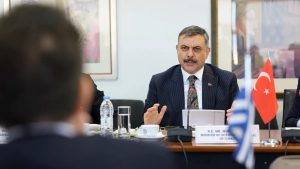
Mitsotakis specifically addressed Turkey’s reaction to Greece’s renewable energy spatial planning framework and the renewed Turkish claims concerning “gray zones.”
“Our position is clear and does not change: Greece acts on the basis of international law, exercises its rights and will not allow threats or illegal claims to determine its decisions,” he said.
He stressed that Athens continues to seek dialogue and good-neighborly relations with Ankara, but added: “Dialogue does not mean retreat. And it certainly does not mean that we will stop doing what we consider right and necessary for our country.”
Water projects move forward in Crete
Water management projects in Lasithi, eastern Crete, are moving forward following the signing of the relevant agreement.
The projects involve two separate irrigation networks, at the Chochlakia reservoir and the Agios Ioannis dam in Ierapetra.
The first section, in the Municipality of Sitia, is expected to begin operating within 18 months, while the entire project is scheduled for completion within 42 months.
Mitsotakis linked the projects to the climate crisis and the pressures facing the Mediterranean, saying that “the era of water abundance and waste of water resources has passed.”
Every cubic meter of water now has strategic value, he said, particularly for the agricultural sector.
New digital platform for agricultural subsidies
The new myAGRO digital platform is now the system for submitting applications for Greece’s 2026 agricultural subsidies.
According to Mitsotakis, the process has been simplified, handwritten lease agreements are no longer required to be uploaded, and subsidies will be linked to real and cross-checked data.
Farmers who submit their applications by Sept. 15 are expected to receive an advance payment by Oct. 31. For the remaining applications, the deadline for advance payments is Nov. 30.
Applications may also be submitted on behalf of farmers by professionals including agronomists, veterinarians, foresters, accountants and accounting firms.
“The goal now is very specific: for subsidies to reach correctly and on time those who are actually entitled to them,” Mitsotakis said.
New rules target electricity “tourism”
Mitsotakis also discussed a new regulation by the Environment and Energy Ministry targeting so-called “energy tourism” — the practice of consumers leaving electricity bills unpaid and repeatedly switching energy providers.
Under the new system, suppliers will be able to notify Greece’s electricity distribution operator, HEDNO, of overdue debts.
If a consumer receives three such notices, they will not be able to switch providers until the debt has been paid or placed under a repayment arrangement.
Mitsotakis clarified that the measure is not aimed at people experiencing genuine financial difficulties who are trying to arrange payment of their debts, but at “strategic defaulters” who, he said, shift the cost onto consumers who pay their bills consistently.
Cancer survivors gain legal “right to be forgotten”
Mitsotakis also announced legislation establishing a “right to be forgotten” for people with a history of cancer.
He recalled that an initial step was taken in April 2024, when the relevant provision was included in the code of conduct for insurance companies. The protection will now be established by law.
Under the new provision, five years after completing treatment, provided there has been no recurrence, information about a previous cancer diagnosis cannot be used in an insurance contract connected to a loan or another credit agreement.
Mitsotakis said the government had chosen a five-year period even though the relevant European directive allows a period of up to 15 years.
“A person who has left the disease behind should not find it in front of them again years later when they are trying to move forward with their life,” he said, describing the measure as a “fair and longstanding demand” that will now have the force of law.
Mitsotakis remembers three public figures
The prime minister also paid tribute to three prominent figures who died in August: Konstantinos Tsoukalas, Stelios Ramphos and Stefanos Manos.
He described them as leaving behind “three different perspectives on the same Greece.”
Tsoukalas, he said, analyzed the contradictions of Greek society within the international environment; Ramphos sought explanations for the country’s course in its deeper roots; and Manos focused on practical solutions to Greece’s longstanding weaknesses.
Despite their different starting points and ideas, Mitsotakis said they shared a common demand: “to look at ourselves in the mirror without illusions and decide what kind of Greece we want to leave behind.”
Praise for Greek athletes
Mitsotakis concluded his review by congratulating Greek athletes for their achievements in August in track and field, swimming, rowing, sailing, shooting and gymnastics, as well as earlier victories in men’s and girls’ water polo.
He also congratulated their coaches and families, saying the government would continue to support Greek sports and the people involved in them.
“This was the first ‘post-summer’ review. Thank you for your time. Have a good Sunday!” the prime minister concluded.