
 Μake us preferred on Google
 Scientists have finally pinned down how warm-blooded Tyrannosaurus rex actually was, and the answer lines up closely with our own body temperature. The debate over whether dinosaurs were sluggish and cold-blooded or active and warm-blooded has simmered for decades, and while most researchers now lean toward the warm-blooded camp for T. rex, getting an exact number for an animal extinct for 66 million years has proven far trickier than it sounds, since there’s no way to simply take its temperature with a thermometer.
The breakthrough came from analyzing two small tooth fragments belonging to “Thomas,” a roughly 70 percent complete T. rex skeleton housed at the Natural History Museum of Los Angeles County.
Lead author Randy Flores and senior author Robert Eagle, a geobiologist at UCLA, used a dental drill to extract enamel from the teeth, then dissolved the resulting powder in phosphoric acid to release carbon dioxide gas carrying the chemical signature they needed. Running that gas through a mass spectrometer let them measure how rare isotopes of carbon and oxygen had bonded together within the enamel, bonds that form more readily in cooler conditions and less readily in warmer ones. Because tooth enamel resists chemical change far better than bone over millions of years, it made an unusually reliable prehistoric thermometer.
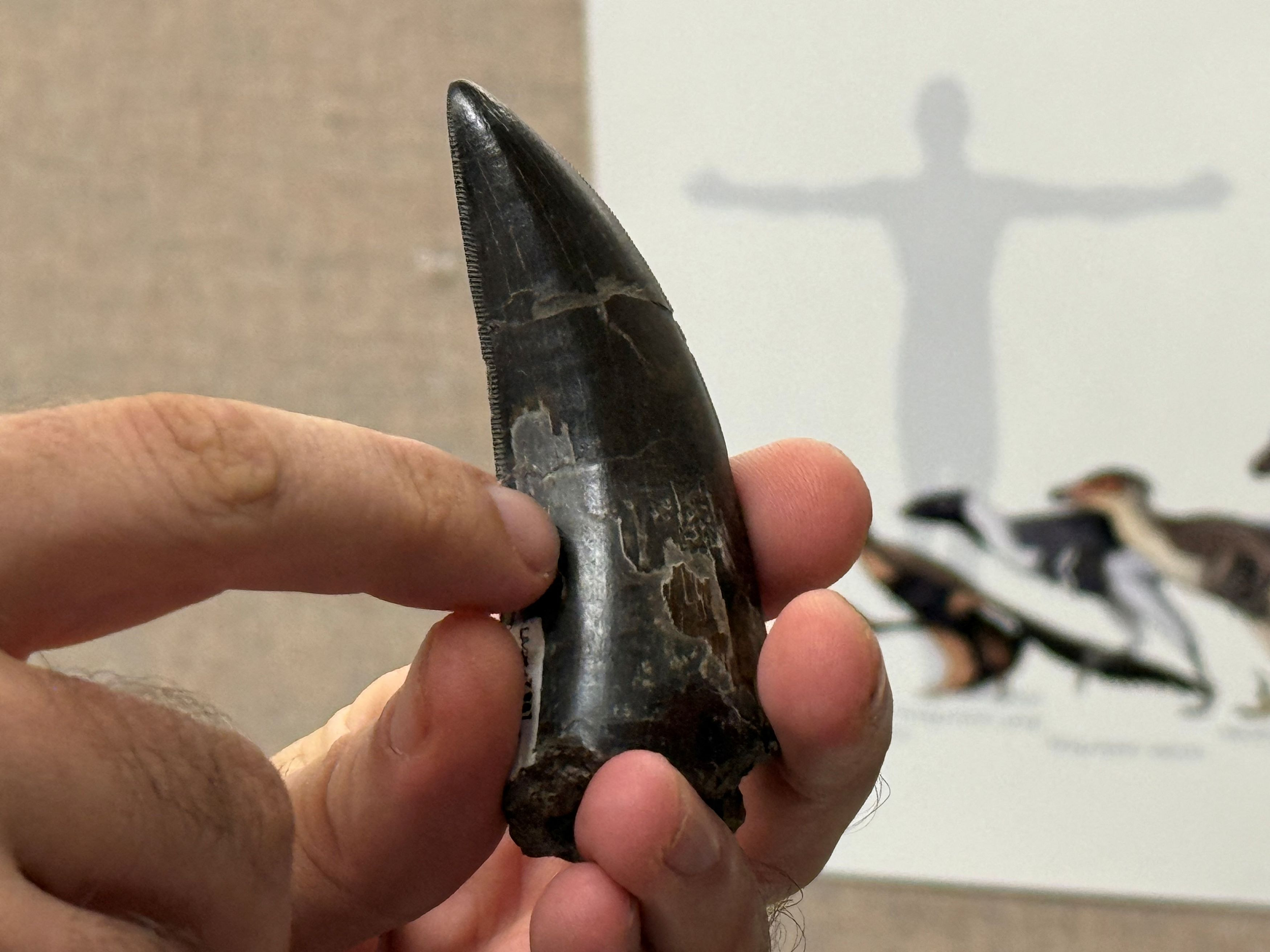
UCLA researcher Robert Eagle holds a Tyrannosaurus rex tooth, provided by the Natural History Museum of Los Angeles County, used in a study measuring this dinosaur’s body temperature, in Los Angeles, California, U.S., in this handout image released on September 16, 2026. UCLA/Handout via REUTERS
Getting museum curators to hand over T. rex tooth material wasn’t easy either. The research team spent more than a decade refining the technique, eventually cutting the amount of fossil material required by about 90 percent, which is what finally convinced the Los Angeles museum to part with small samples from two teeth that weren’t on public display. “Nobody can measure a T. rex tooth unless you can show them you only need a few milligrams,” said UCLA geochemist and study co-author Aradhna Tripati.
The results placed T. rex’s average body temperature at about 97.3 degrees Fahrenheit (36.3 degrees Celsius), close to that of a modern elephant and not far off from typical human body temperature. That’s notably warmer than modern cold-blooded reptiles, which generally run around 82 to 86 degrees Fahrenheit (28 to 30 degrees Celsius), but still cooler than most modern birds, T. rex’s distant warm-blooded descendants, which often run between 104 and 109 degrees Fahrenheit. “No one’s been able to make a temperature measurement like this before,” Eagle said, adding that the number was roughly what he expected, warmer than a reptile or a slow-moving mammal like a sloth, but cooler than a bird.
Study co-author Alessandro Chiarenza, a paleontologist at University College London, said a body that ran this warm would have let T. rex tolerate a wider range of habitats, including cooler regions where a true cold-blooded animal would have struggled to survive. That internal thermostat likely supported an active hunting or scavenging lifestyle rather than the sluggish, sun-basking image once associated with dinosaurs, and helps illustrate just how far tyrannosaurs had already evolved away from cold-blooded reptiles and toward the metabolism of their modern bird descendants.
The findings, published Wednesday in Science Advances, weren’t quite what everyone anticipated. Johns Hopkins paleobiologist Jasmina Wiemann, who wasn’t part of the study, said she’d expected a slightly higher reading based on her own earlier work, closer to that of modern birds. Researchers now hope to apply the same method to other dinosaur species to build out a fuller picture of which lineages ran hot and which ran cold, and whether T. rex’s particular temperature gave it an edge as one of its era’s dominant predators.