 Μake us preferred on Google
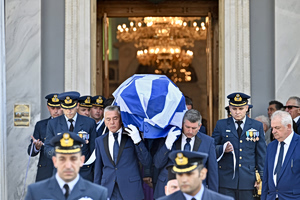
 The recent crash of an F-4 Phantom during an air show at Tanagra, which claimed the lives of two experienced Air Force pilots, prompted a look back at aviation accidents in Greece over the past ten years. None of these incidents involved a passenger airliner crash; rather, they involved military aircraft, firefighting helicopters, training planes, transport aircraft, private helicopters, and single-engine planes.
The Hellenic Air Force alone has lost more than 130 people and nearly 100 aircraft since 1990. The Army Aviation branch has lost 26 people and 8 helicopters, while the Naval Aviation branch has lost 9 lives and 3 helicopters. Based on available records and official findings, fatal aviation incidents in Greece over the past decade have claimed the lives of 50 people across all categories of aircraft. Difficult operational conditions, combined with the rise of private aircraft operating without strict adherence to safety regulations, appear to be contributing factors.
Experts agree that human error remains the leading cause of aviation accidents, which undergo thorough investigation, producing findings aimed at preventing future incidents. For roughly two decades, until 2023, the body responsible for investigating aviation accidents in Greece was HAAI (Hellenic Air Accident Investigation), which was later merged into the National Accident Investigation and Aviation and Railway Transport Safety Board (NAIASB), the organization that became widely known following the Tempi rail disaster. HAAI’s findings from previous years remain published and publicly available.
The Timeline
In October 2016, a Cessna 172 crashed east of Kalavryta in a mountainous area blanketed in dense fog. Both people on board died.
In April 2017, Greece experienced one of its most severe military aviation tragedies in recent years. An Army Aviation Huey helicopter went down near Sarantaporo in Elassona during a routine flight. Four officers were killed, with a non-commissioned officer the sole survivor. She later described the helicopter flying in limited visibility before striking power lines. That same June, a crop-spraying helicopter crashed in the Schinias area, also after hitting power lines, killing two people. Just days later, a small aircraft crashed near Dendra, Larissa, killing two.
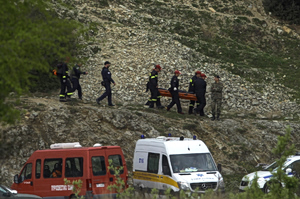
Four dead and one injured in military helicopter crash in Sarantaporo, Elassona (Eurokinissi/Michalis Batziolas)
In April 2018, an Air Force Mirage 2000-5 crashed nine nautical miles northeast of Skyros, killing Squadron Leader Georgios Baltadoros. On August 28, during a training exercise north of Sparta involving a T-2 Buckeye, both pilots ejected from the aircraft. The co-pilot survived by parachute, but Wing Commander Nikolaos Vasileiou was later found dead. That same April, a Piper PA-28 crashed near Nafpaktos, killing two.
On August 20, 2019, a helicopter that had taken off from Galatas bound for Athens crashed into the sea near Poros after striking medium-voltage power lines. All three people on board were killed. Years later, a judicial investigation would revisit the issue of cable marking, with a court ruling finding that Greece’s power grid operator, DEDDIE, had failed to take required safety measures despite prior warning.
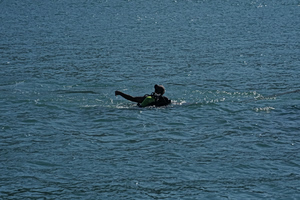
Private Helicopter Crashes Into the Sea Near Poros island, Greece, on Aug. 20, 2019. Credit: SOOC
The 2020s
In September 2021, a Cessna that had departed from Israel bound for Samos crashed into the sea near Pythagorio.
One of the decade’s worst disasters occurred in the summer of 2022. A Meridian Antonov An-12 cargo aircraft, flying from Serbia to Bangladesh, suffered a mechanical failure and attempted an emergency landing toward Kavala before ultimately crashing near Antifilippi. All 8 crew members were found dead.
In 2023, Greece lost two more pilots when an Air Force Phantom F-4 crashed in the Ionian Sea during a training mission. Flight Lieutenant Marios Touroutsikas and Squadron Leader Efstathios Tsitlakidis were killed. That September, a small aircraft also crashed near an aero club in Thebes.
In 2024, the Civil Aviation Authority’s annual review recorded six accidents, two of them fatal.
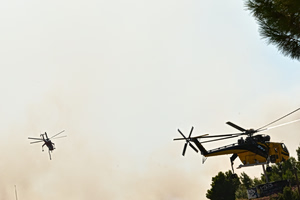
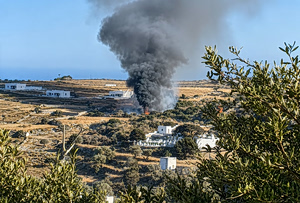
This year alone, three incidents have already been recorded. The first occurred during aerial firefighting operations battling a major wildfire near Psatha, when two helicopters collided mid-air. The Danish pilot and the Greek liaison officer aboard one of the helicopters were killed. Just days later, a Bell 206 crashed on Sifnos just meters from the helipad, killing the 55-year-old Greek pilot and a British couple on their honeymoon. Most recently, the F-4 Phantom crash occurred during the Athens Flying Week air show.