 Μake us preferred on Google
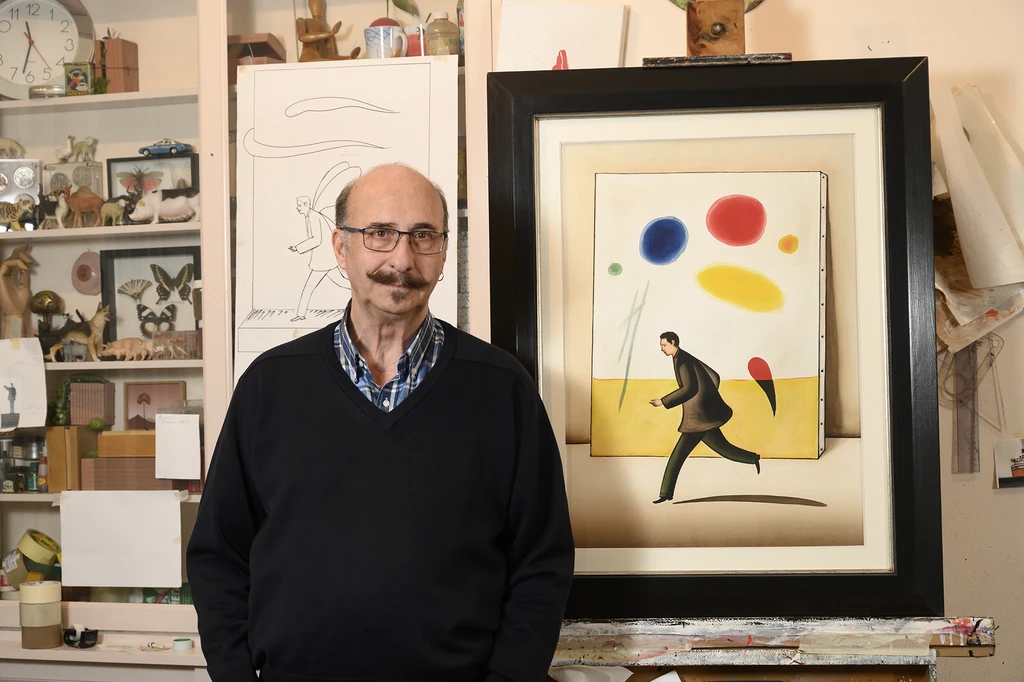
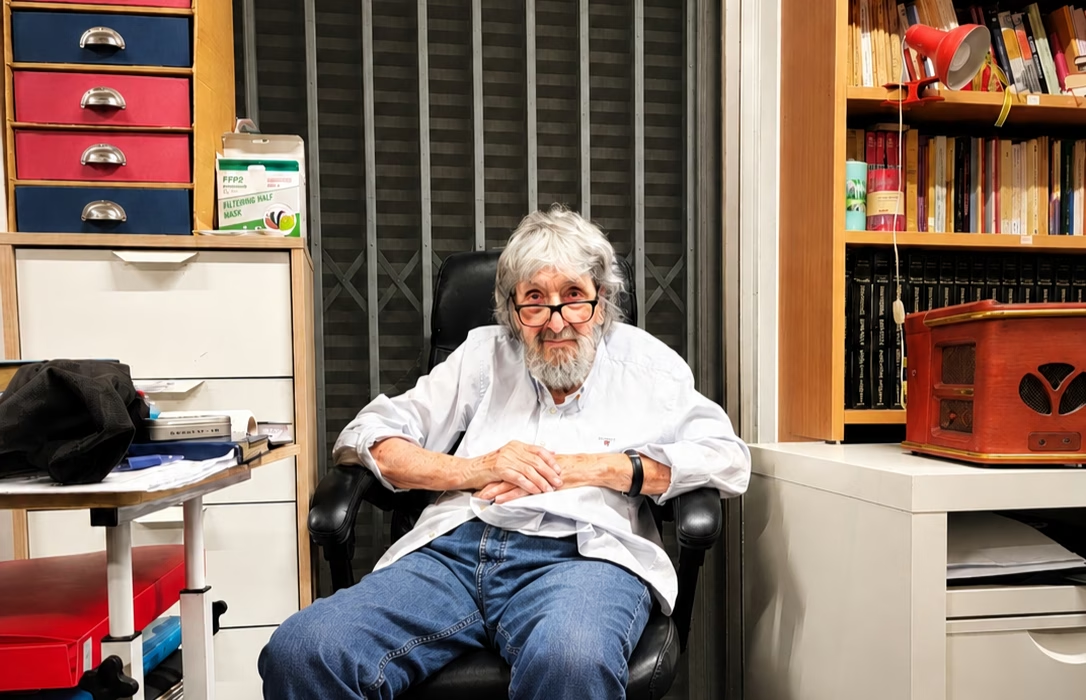
 It’s hard to know what to focus on first, when you cross the threshold into Sotiris Sorogas’ studio. Books towering in every corner of the space, works on standby, waiting for their next brushstroke, photographs of his beloved daughter Erifyli, letters from Kiki Dimoula, Manos Eleftheriou and George Seferis, which he preserves in his archive with exemplary reverence, photographs of his students from the Architecture Faculty at Athens Polytechnic, who remain devoted to him and continue to visit even after their own retirement, exhibitions catalogs and portraits of all “those who tormented us; and who weigh heaviest on our hearts”, as the poet says. And just like that, in a matter of minutes, the space where Sotiris Sorogas works is transformed into much more than just an artist’s studio.
It becomes a space where the intellectual life of Greece’s last six decades continues to breathe silently and to converse as much with aesthetics as with the source of his inspiration. He himself navigates all this without the slightest hint of showing off. As if these are not his personal heirlooms, but rather objects that continue to have a place in his everyday life.
It is one of those rare encounters in which you quickly exchange the role of journalist for that of listener. Sotiris Sorogas narrates his life with a generosity one rarely encounters in this day and age. He talks about his teachers, as well as the people who made him who he is today as tenderly as he talks about painting, without ever separating the work from the life. And when the conversation reaches its end, he stands up quietly, picks out some of his books, opens them to the front page and writes a personal dedication in his familiar style, from the heart.
A little later, as I’m leafing through his book, I can’t get a phrase of his, one that had made a great impression on me as a teenager, our of my head: “One of the reasons it saddens me that I’m going to die is that I won’t be able to read again.” Returning to that space, it’s clear the books are so much more than an artist’s library; they are the most eloquent brushstrokes in the portrait of Sotiris Sorogas the artist and the man.
Mr. Sorogas, you are part of the seminal postwar generation that emerged on the art scene in the 1960s.
How did you experience that period of intense political and intellectual searching in Athens, and what were the milestones along the way for you personally?
Looking back on the years of that truly intense, restless yet also curiously optimistic era, I remember how insuperable the barriers seemed to actually making a living from an art that never promises you anything.
Still, they were fruitful, happy years, marked by high points of ideological and artistic inquiry, with a lot of reading and dream-filled artistic horizons. When I was demobbed, in ’63, my activities began to intensify in a singular way. I was like someone discovering a miracle concealed in every aspect of life. That sense of surprise remains with me to this day, which is why the awareness that I’ve now lived my life sharpens the sorrow of departure.
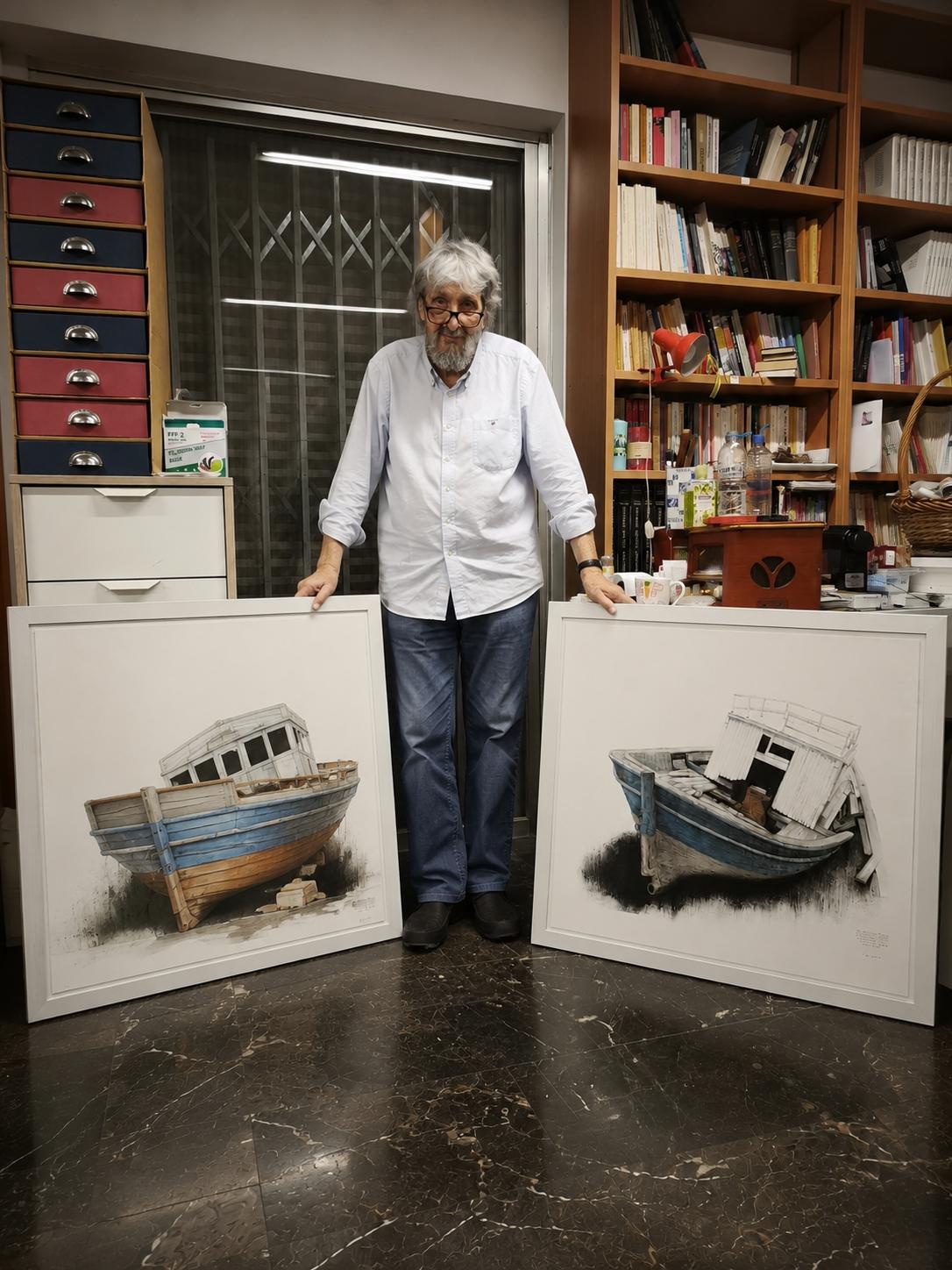
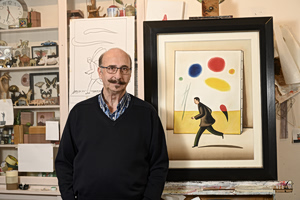
Sotiris Sorogas in his atelier, with two of his boat paintings. PANOS KOUGIAS/TO BHMA INTL EDITION
You studied at the Athens School of Fine Arts under teachers like Yiannis Moralis.
What has stayed with you from Moralis’s teaching, and how did you manage to distance yourself from his immense artistic vision to find your own absolutely recognisable and captivating voice?
Moralis was exceptional, an amazing teacher with an incredible knowledge of a difficult art—because painting is hard.
He knew a great deal about how a composition is constructed out of colored shapes and light, whose revelation could open doors of creativity, if expressing yourself was what you desired. Meaning that he knew the laws and rules that govern compositions. He spoke of simplifying surfaces, secret correspondences between different parts of a composition, color harmonies, and specific uses of light. Moralis’s teaching was expansive and non-prescriptive, which is why no one copied his painting style. And I don’t think more than a handful of his students imitated him. I tried to continue his teaching in my turn during the 40 years I taught in the School of Architecture.
Before it was published, I gave Moralis a summary of my own teachings to read, to see if he agreed. I am moved whenever I recall our last meeting, at the Benaki Museum a few months before he passed away. Vasso Kyriaki and Antonis Kyriakoulis were there, too.
For decades, you taught Drawing and Color at the National Technical University of Athens.
How did the continuous interaction with young people affect you?
My contact with the students in the School of Architecture was one of the most joyous experiences in my life. I was always deeply committed to them, and this love and interest were reciprocated. Interestingly, when I invited Dimitris Mytaras to give them a few lessons as a visiting professor, he—being a fellow student of Moralis—referred them back to exactly the same teaching without any prior coordination on our part.
In 1972, you received the annual Ford Foundation grant, which allowed you to travel and study contemporary art in New York and Europe.
How did this international experience impact you at a time when Greece was still under military rule?
We had taken care to learn about European art back in our student years, and several of us had already been to Paris and Italy. I don’t think the Colonels stopped us wanting to express ourselves. In fact, I’d say the dictatorship added impetus to our activities, as we tested the limits of risk-free—or as safe as possible—forms of resistance. Others went abroad. Curiously, the Ford Foundation grant was almost always awarded to individuals or institutions with a ‘dissident’ profile. The late Kaiti Myrivili was largely responsible for making these selections in Greece. She liked my work, which I had just presented in my first exhibition.
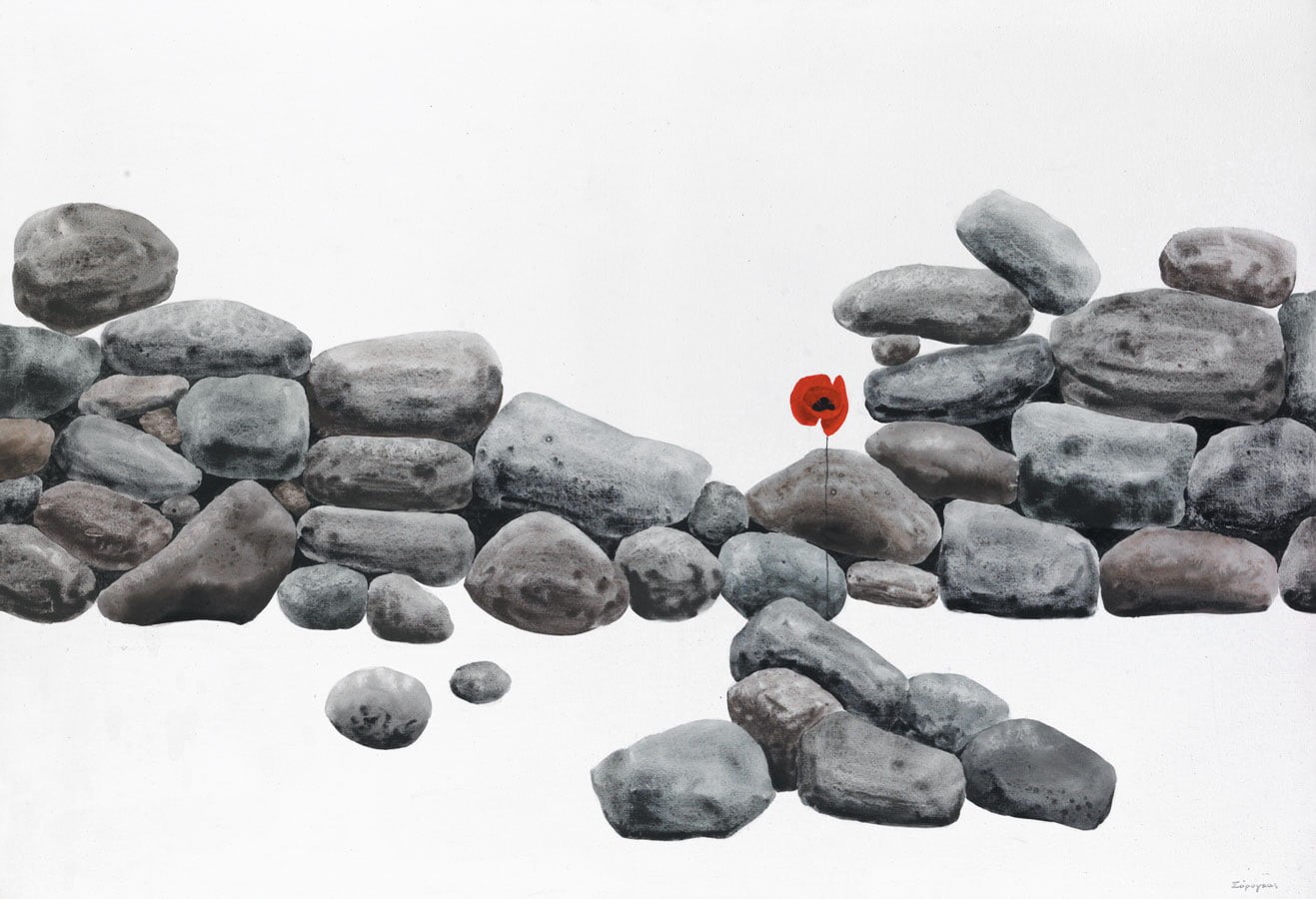
Petres, one of the most recognizable painting series by Sotiris Sorogas.
The grant allowed me to visit the most important museums in Europe and the US and meet fellow artists. I believe the experience bore fruit in my later work. I didn’t know Myrivili beforehand, but we became good friends after that, and I was lucky enough to meet Maronitis, Tachtsis, Zongolopoulos, Karas, Kechaidis, Lefteris Poulios, and a good many others at the wonderful soirées she hosted at her home .
Your works, whether they be old rusted metals, driftwood, stones, or wells, are a study in decay and the passage of time.
What made you choose to give a “voice” to objects that society considers useless or abandoned?
It’s hard to talk about things that stem, I believe, from our individual psyches and our interpretation of life.
I don’t mind telling you that my love of life may verge on the immoderate, since my gaze almost always finds companionship in the dying, in things on the verge of loss. You need only recall what you remember of my subjects. Even the portraits are like funerary monuments.
The color white, or rather the “negative” of the canvas, is a co-protagonist in your work. What does it symbolize for you?
It is the eternal interplay between light and darkness. It is ambiguity and duality. It is the angelic and the black light in the poetry of Seferis, of Kalvos, of Byzantine icons and ancient tragedy. It is the canvas on which I think all art converses. I try to infuse my subjects with a sense of how the world exists for me, as a form of confession.
Your painting has a deeply poetic and philosophical dimension, which many connect with the “Greekness” of Seferis or Elytis.
Do you feel like a “poet who paints”?
I would be happy indeed for my work to have “a deeply poetic and philosophical dimension” connected, as you say, with the specifically Greek quality of our two great poets.
I believe that everyone who paints is actually laying bare their soul in the way they know best. This is reflected in their work, which is simultaneously influenced by various other elements and events. Quite often, these modify their efforts holistically, as well as their ability to narrate their world.
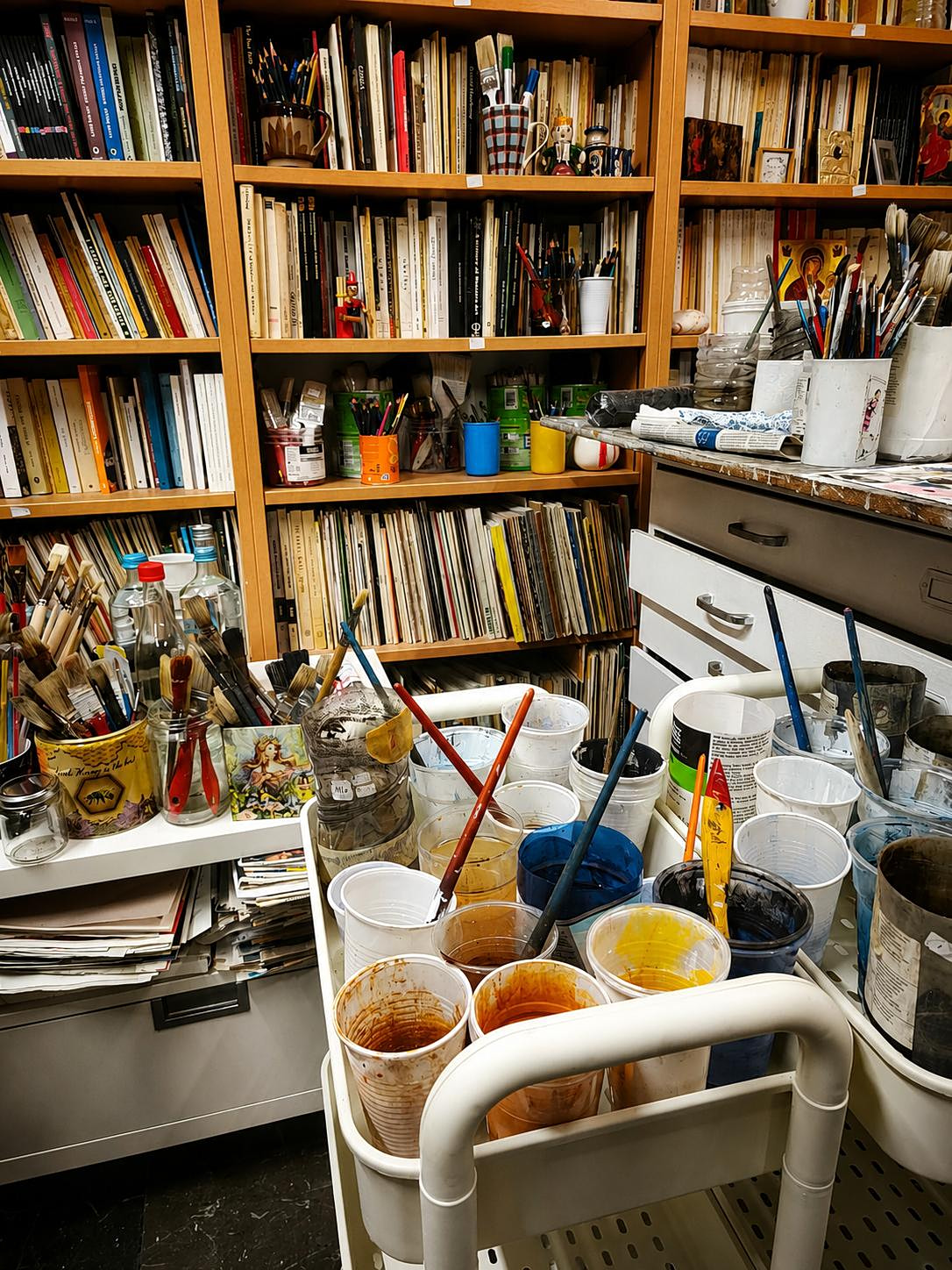
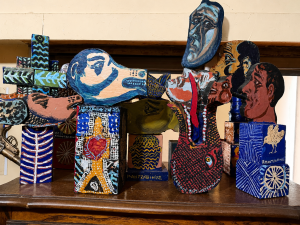
Tools, books, and miscellaneous items—all playing a unique part in the artist’s process.
You represented Greece at the São Paulo Biennial in 1981 and your work has been shown in international exhibitions.
How do international audiences perceive the deeply internal, almost “ascetic” Greekness of your paintings?
I think your question requires a nuanced perspective on whether and how other criteria might be at play for a non-Greek audience, shaping how they engage with the painting.
I believe that such an audience is either non-existent or exceptionally rare, due to virtually every museum of modern art having long since succumbed to an addiction to a commercialized, mass, kitsch culture in what they choose to showcase. You will have noticed for yourself that painting is marked by its absence. I think few artists today have remained faithful to this wonderful art of nuance, of allusion, of tender feelings and contemplative meanings.
The monumental “carts” at the Larissis Metro station are a daily meeting point for thousands of citizens. How does an artist feel when their work emerges from the silence of the studio and the gallery and becomes part of the public sphere and people’s daily lives?
I remember being delighted when the Athens Metro proposed exhibiting works of mine there. It was a fine opportunity to start up a conversation between my work and the general public—everyone who ever finds themselves in front of an art-work without meaning to—and not only with art lovers. I considered the subject exceptionally well-suited to the works. The old modes of transport—a train, a tram, a cart—would serve as a reminder of the fate that awaits all things. In fact, this reminder may actually be at the very core of the things I spent so many years of my life painting. As for the recognition you kindly refer to, that question has always left me at a loss.
You have frequently expressed unease about the direction modern culture is moving in. In an era of absolute digitization, speed and ephemeral images, what can painting offer?
I believe that painting is a highly spiritual art with infinite expressive possibilities.
After all, it is inextricably linked with mankind’s history, given that painting found the way to narrate and give physical form to every need, every religion and ideology, every culture. Nowadays, “the dominance of the ephemeral image,” as you put it, has made painting, with its inherent density of meaning and emotion, into an impenetrable form of communication. Our contemporary, kitsch-culture-addicted museums of modern art have given themselves over to a mass of rubbish that seeks—in vain, as is now clear—to substitute itself for art.
Do you believe that we have lost the “thread” and the essence of artistic creation?
I believe that the commercialization of everything at the hands of a predatory capitalism, as Chomsky would say, has led to the desecration of every aspect of our lives.
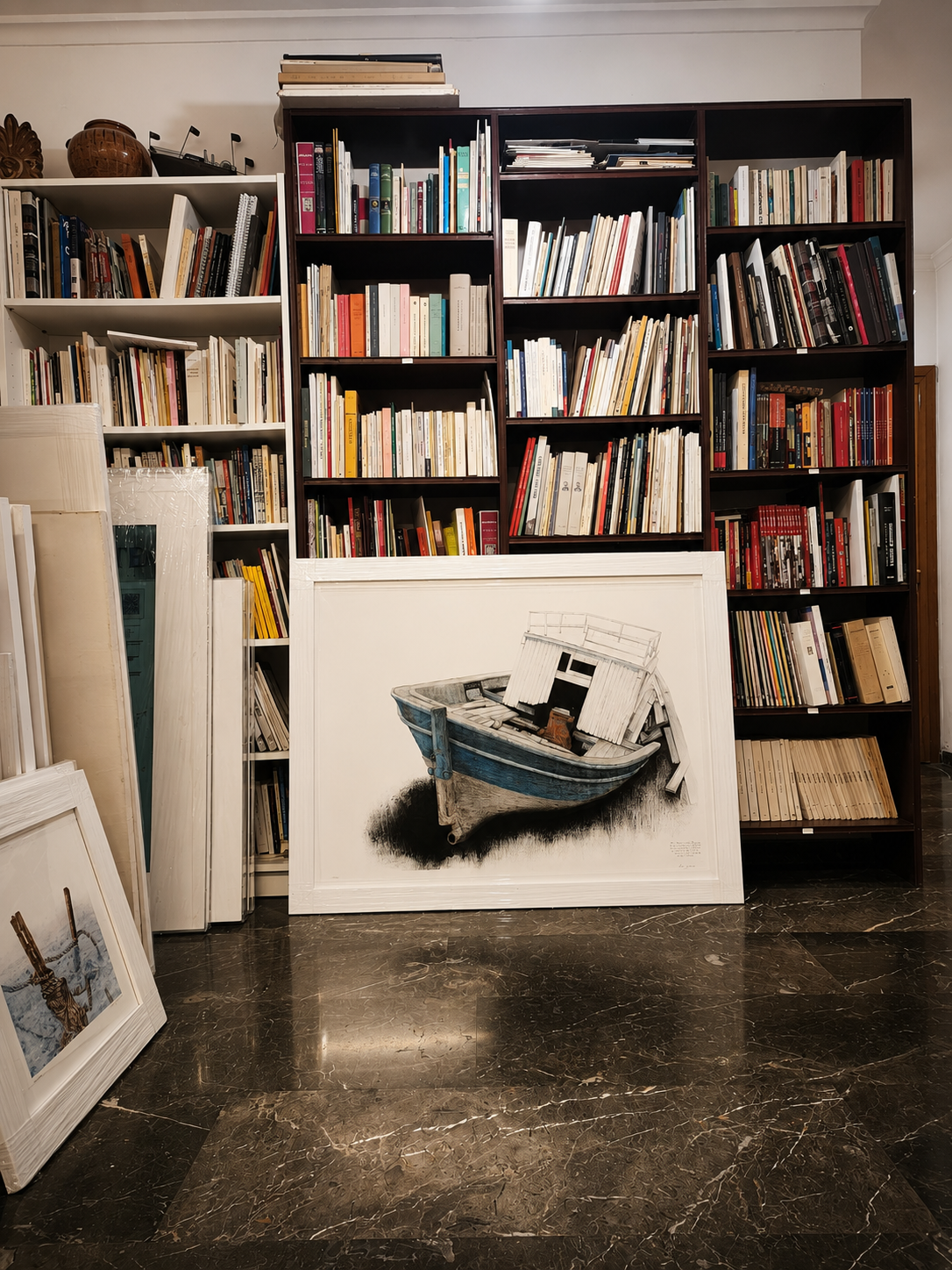
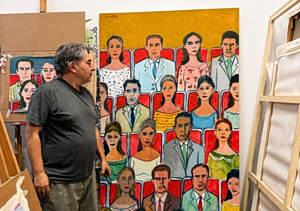
PANOS KOUGIAS/TO BHMA INTL EDITION
The negation of the intrinsic value of the spirit, too, and its incorporation into the transactional dealings of a mercenary mindset, has eroded, if not entirely eradicated, the meanings of life, our codes of communication and moral values. And art, inevitably integrated as it is into our contemporary, multifaceted social framework, has I believe become a mouthpiece for, and ally of, the impasses we now find ourselves in. I hasten to add that the broad formulations and generalizations of issues such as these, which I am touching upon so superficially here, cannot be simplified with impunity.
Looking at Greek society today, with all its contradictions and crises, its intellectual and spiritual quests, are you optimistic about the future?
I feel that attempting to answer your questions would force me to forfeit any claims I may have to being a serious person, given that the fate of the country hangs in the balance and hinges on these questions and our response to them.
All I can tell you is what I would like to change. Not, of course, by holding back technological achievements, but primarily through the preservation of our Greek intellectual tradition. I believe—like many Greeks, though not all—that this tradition is unique in the breadth and depth of its meanings, compared to any other intellectual tradition in the world. And this tradition cannot survive, unless—first off—we protect the three-thousand-year-old language in which it is expressed. And one other thing: I can’t understand why we suffer from such a sense of national inferiority?
Can art function as a cure or a compass in an era of generalized disorientation?
Engonopoulos used to say that art helps us to die.
If you ran into the young Sotiris Sorogas as he was just starting his studies in Art, what would you say to him?
I’d tell him to act in a way that won’t cause embarrassment later.