 Μake us preferred on Google
 The Historical Archive of To Vima and Ta Nea newspapers continues its tribute to the late Dionysis Savvopoulos — one of the most influential Greek singer-songwriters of the 20th century.
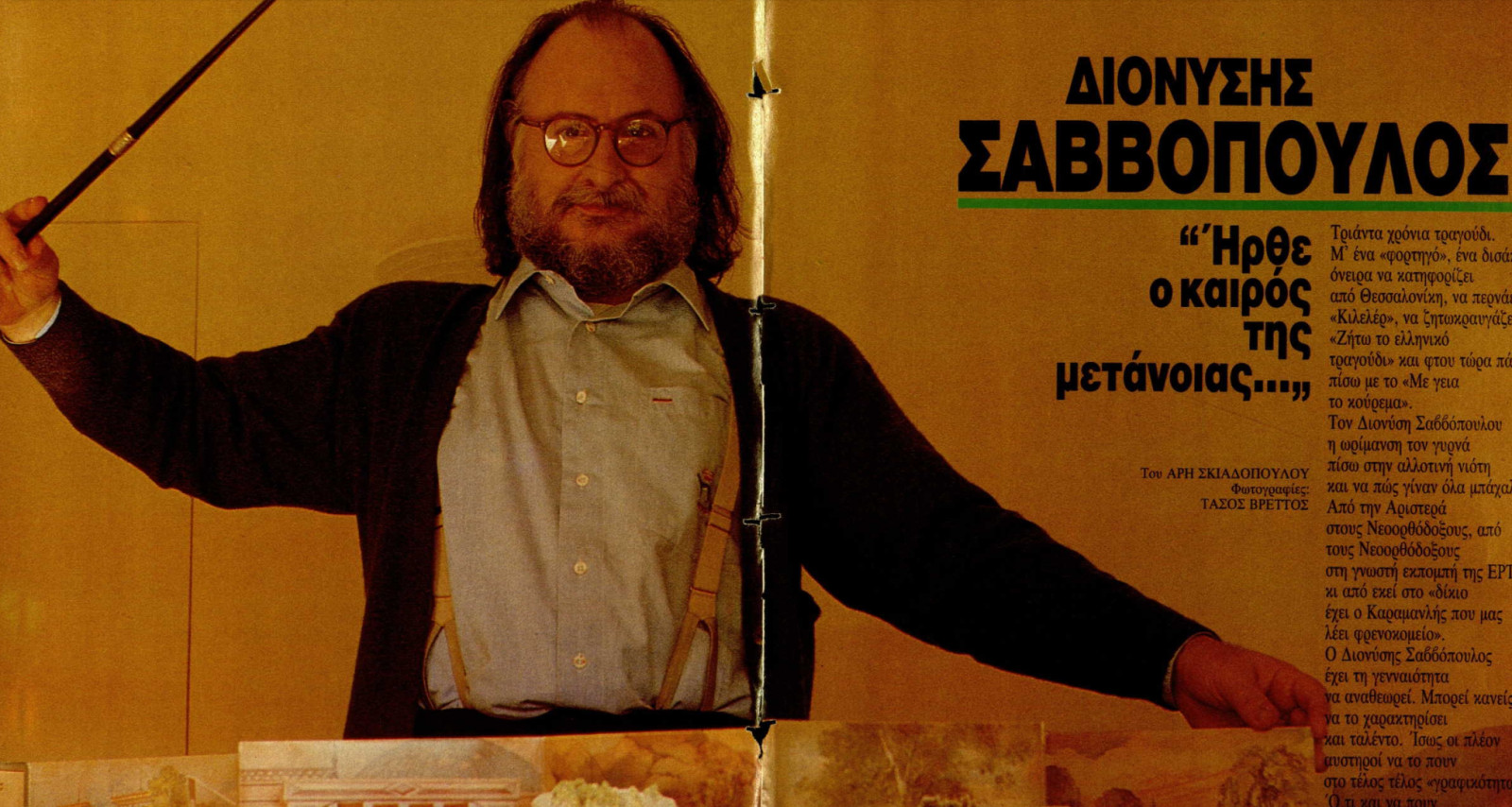
In January 1989, at a time of deep political tension and rampant scandal in Greece, Savvopoulos spoke to journalist Aris Skiadopoulos for Tachydromos magazine.
“The Time Has Come for Repentance…”
Thirty years of song. With one “truck” — To Fortigo (“The Truck,” his landmark 1966 debut album) — carrying a sack full of dreams from Thessaloniki, passing through “Kileler” (a song about the peasant uprisings of early 20th-century Greece), shouting “Long live Greek music!” and now, full circle, back again with “Me gia to kourema” (“Enjoy your haircut”).
Maturity, for Dionysis Savvopoulos, means returning to youth — and seeing how everything turned into chaos.
From the Left to the Neo-Orthodox movement, from the Neo-Orthodox to public television, and then to saying: “Karamanlis was right to call us a madhouse.”
Savvopoulos has the courage to rethink himself — a quality one might call talent, or perhaps, as stricter critics might say, eccentricity.
Whatever one calls it, he remains a soul in search — as restless now as we were, the teenagers of the 1960s.
“Let Me Not Speak About My Songs Now”
“Let me not speak about my songs now,” he begins.
“In some ways I’ve moved forward, in others not. What I’ve observed over the past thirty years is this: the Left is no longer persecuted — it’s become established. Therefore, it can no longer inspire us as it once did.”
The Persecuted Left
Isn’t it rather sad, though, to say that the Left inspires only when it’s being persecuted?
“Yet that’s what happened,” Savvopoulos replies.
“The old fighters gave their struggle an almost eschatological meaning — something metaphysical. Marx himself never spoke of that; he spoke of class percentages and economic indicators. But man is man — and when he’s Greek, sentimental, he cannot fight passionately without feeling some fever of heaven burning inside him. That, in a way, sanctified the world of the Left and its sacrifices.”
Why only to a point?
“Because they didn’t have a truly metaphysical consciousness of their struggle. So when they were vindicated, they often became just as oppressive or authoritarian as their former persecutors.”
Authoritarianism and Self-Criticism
“So you experienced oppression yourself?”
“Yes,” he says. “I suffered it — and I fear I may have exercised it against others, too. When you believe you’re right and everyone else is wrong, when you think that ‘Change’ means everyone must change except you — that mentality leads to grotesque behavior.
Unfortunately, we live in days when all our childhood dreams have come true — and that’s the tragedy. Why say that Change (referring to the socialist “Allagi” movement of the 1980s) failed? On the contrary — it succeeded, and that success brought about the decay of everything. What else could come from a change driven by such egoism?”
A Left That Cannot Inspire
“So, a Left that’s no longer persecuted can’t inspire?”
“I don’t think so,” he answers. “At best, it can show professional political conscience. For example, taking polite photos with Mr. Mitsotakis (then the leader of the conservative New Democracy) or the President of the Republic. I actually find that positive — it shows that fear of chaos keeps opposition politicians disciplined, professional. That’s a small guarantee, yes. But what inspiration can one draw from that?”
A Nation in Decline
“Doesn’t such a situation have social side effects?”
“What side effects?” he laughs bitterly. “I feel that, as a people, we’re finished. We’ve settled comfortably into well-being (efzoia). Comfort isn’t bad — why shouldn’t people have their conveniences? But when comfort replaces virtue, when pleasure becomes the ultimate good, why shouldn’t Koskotas (the banker at the center of Greece’s 1980s corruption scandal) steal, or Papandreou become a seventy-year-old adulterer?
What’s to stop the moral slide when self-interest rules everything? We’re corroded — because the first thing well-being destroys is filotimo (the uniquely Greek sense of honor and moral pride). Once that goes, nothing holds us together.”
“A Madhouse”
“All this reminds me of Karamanlis’s recent remark — that Greece has become a madhouse…”
“Of course,” Savvopoulos replies. “Karamanlis’s statement expressed the common feeling. That moderate man has proven, over time, to have had more sense than many of the supposedly brilliant figures of our political scene who ruined everything with their grandiosity.
This man of moderation, of common sense, has turned out to be one of the most positive personalities of recent decades. Pity we disliked him when we were young — another mistake of my generation.”
Rumors and Politics
“Some might connect what you say with the rumors before the local elections — that you were planning to run with Mr. Evert’s list?”
“No such thing,” he laughs. “We just shared a pasta dinner once, and suddenly the papers had me running for office! Though I like Mr. Evert — he’s articulate, precise, has common sense — I’ve never once thought of becoming a candidate.
Not with him, not with anyone. It doesn’t suit me.
As for what I said about Karamanlis — yes, it may irritate some. I don’t care. What matters to me is that the time has come for repentance. People shouldn’t just reconsider their vote — they should reconsider a whole part of themselves.”
He pauses, then adds:
“We went through seven years of dictatorship. Then seven years of the metapolitefsi (the post-1974 restoration of democracy), when the ugliness this time came mostly from the so-called democratic camp. What rhetoric! What anti-imperialisms! Empty words, cultural melodrama, progress that was actually regression. Then came seven years of PASOK — and the boat finally sank.”
Broad Consensus
“But in all that, Karamanlis still managed something, didn’t he?”
“Yes,” says Savvopoulos. “He set the rules of the political game and achieved a broad consensus among parties on how democracy should function. That’s no small thing for a country like Greece.
The best years, in my view, were when Karamanlis was President and Papandreou was Prime Minister. Nothing spectacular happened — but we all felt hope, relief, a sense that life was improving and that Greece would finally find its place in the world.
Symbolically, the Civil War ended then. But apparently, we didn’t want it to end — and this time, the fault was ours. Those of us who tolerated or approved of Karamanlis’s politically and morally unacceptable removal paved the way for Koutsogiorgismos (corruption), Tobismos, and Koskotismo. We even reached the point where a newspaper like Avriani could dictate the political agenda.”
Madness and Survival
“And now,” he continues, “we see newspaper burnings — who knows what comes next. Both major parties should have access to power, as in ancient Sparta, where two kings ruled together.
If Mitsotakis wins now, he should appoint Florakis (the Communist leader) or someone from the opposing camp as President. But is Mr. Mitsotakis that wise? That brave? This lesson — one of coexistence — begins with Karamanlis. It’s crucial for our survival.”
Repentance
“So, after thirty years of turmoil, are we back to square one?”
“No,” he smiles. “We’re not going back. But we must have the courage to repent sometimes. Metanoia literally means ‘to think afterward’ — to think beyond what you once thought. Without that, my generation’s schizophrenia will go on forever.”
“Are we mad, then?”
“Well, we definitely have a psychological problem.”
The Schizophrenia of a Generation
“What kind of psychological problem?”
“For thirty years,” he says, “we’ve felt compelled to act revolutionary — to rebel — while our inner nature, shaped by our parents’ conservatism of the 1950s, is deeply traditional.
My generation behaves like the Left but thinks like conservatives. That schizophrenia may be fertile in art, music, and love — but in politics, it paralyzes us. That’s why others always got ahead of us.”
He reflects for a moment.
“There’s a study about the metapolitefsi showing that while politics then were vibrant, the 30–40 age group — my generation — was largely absent. We’ve been in reserve for years. To step out of it, we must face our psychological problem — and repent.”
“The Haircut”
“So — ‘Enjoy your haircut,’ as your new show says?”
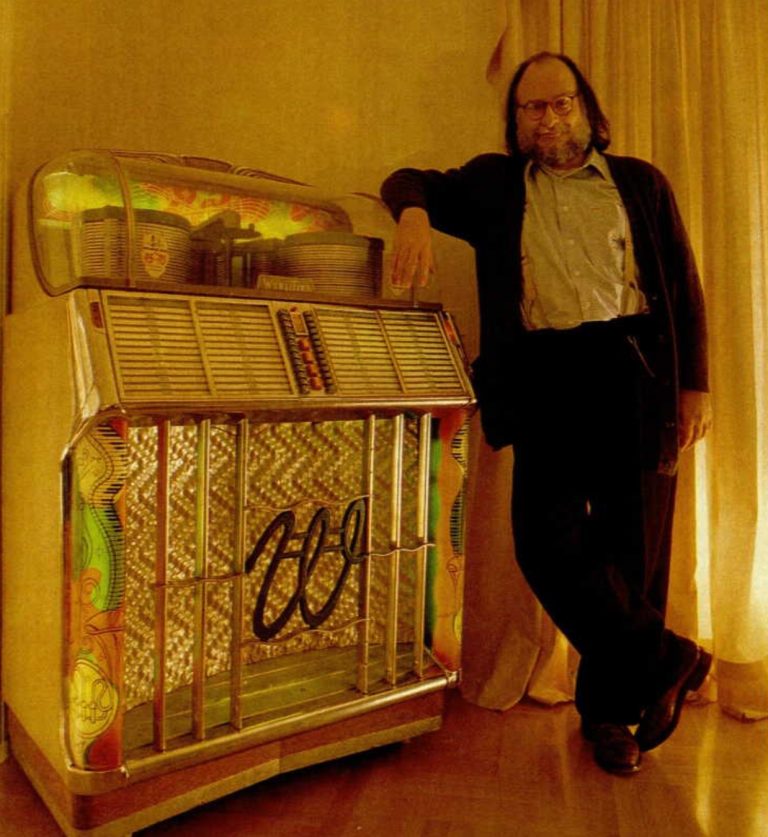
“Yes,” he laughs. “That’s the title of my new program in Plaka (Athens’s old quarter). ‘The Haircut’ or ‘Enjoy the Haircut.’ Probably just ‘The Haircut.’ It’s heavier. More rock.”
Does it have a symbolic meaning?
“Of course! A haircut can mean humiliation, punishment, or self-purification. It’s also part of rituals — becoming a soldier or a monk. Since both professions involve a kind of dying, the haircut represents spiritual death — or cleansing.
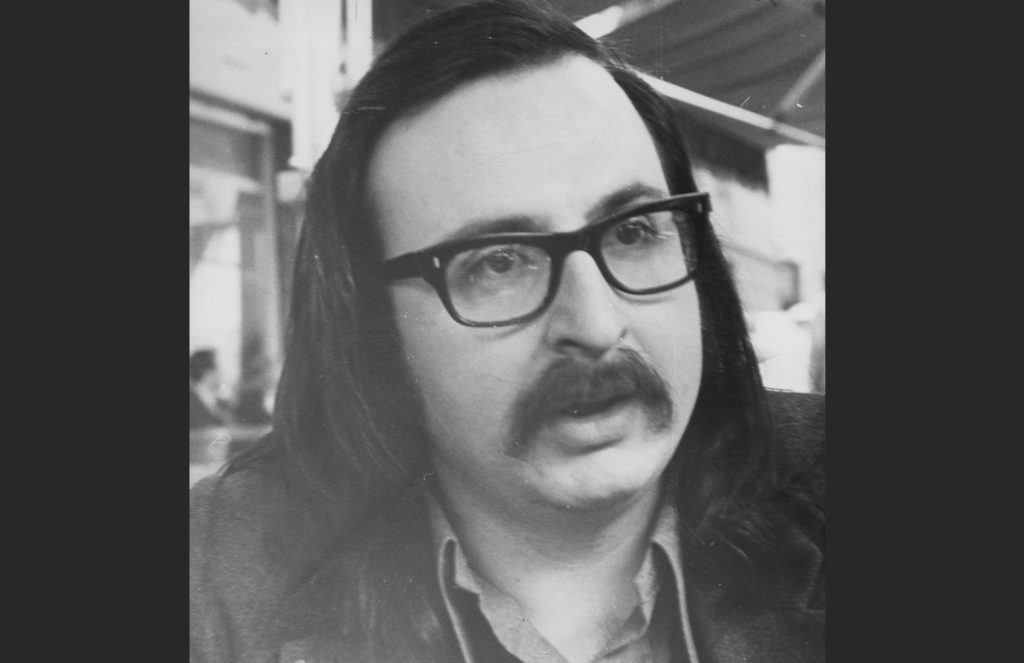
And after thirty years of hazy romanticism with long hair flowing, maybe it’s time to cut it off. I’m half bald anyway, but I still keep a few tufts hanging. It’s my little badge of initiation to the ‘60s generation. But I’m tired of it. I think I’ll walk into a barber’s soon for a good, clean haircut.”

Cleansing, Punishment, or Renewal?
“So what is it — cleansing, punishment, renewal, or just a new look?”
“Let the audience decide,” he smiles. “I’ll be at Zoom from the 20th. Let them search for it in themselves.”
Return to Plaka
“Ten years away from Plaka,” the journalist notes. “You had concerts, ‘Long Live Greek Song,’ ‘Even More Greek Song’…”
“Yes,” says Savvopoulos. “Ten years since I played in Plaka — since Skorpios in 1979. Last year Manos Hadjidakis invited me to perform at Zoom — he called it Sirius. I couldn’t say no. It was just twenty nights. I’d grown out of live shows, but once there, I felt the old sweetness return.
So this year, with new songs ready, I decided to present them live again — as I used to.”
Television and Disillusionment
“And what about your television experience? The current government gave you quite a platform back then.”
“They’re narrow-minded,” he says. “Afraid. Unimaginably bureaucratic. It wears you down. I don’t complain about the shows themselves — I loved the work, and TV as a medium. But the atmosphere — the pettiness that constantly flows from the ERT building in Agia Paraskevi — kills all joy.
It makes you stop loving your job. It crushes your spirit. I’d have stopped eventually anyway. Especially now, when television feels like a grocery store run solely for the grocer’s family.”
“Greek Song Cannot Be Legislated”
“Do you feel vindicated,” the interviewer asks, “now that after your show Long Live Greek Song, Minister Maroudas came out with ‘Even More Greek Song’?”
“Of course not,” he says. “What does that have to do with anything? One of the defining traits of Greek music is its mangia — its raw, uncompromising spirit. How could Greek song accept being promoted by ministerial decree?
Sure, it’s good when a government shows interest in Greek music — but not when that interest is so hypocritical and superficial. We don’t even have a Conservatory of Traditional Music!
Our song has its own system of rhythm, scales, melody, and lyricism. Where are these taught? Where can a kid learn santouri, clarinet, or bouzouki? Only in the nightclubs of Omonia? We’re the only country that has completely thrown away its own music.”
“Because Song Disturbs Power”
“Maybe because song disturbs those in power?”
“Of course,” he nods. “The Greek people have always respected their songs more than their rulers have. Authority always looked at them suspiciously — not ‘European’ enough, not ‘proper’ enough.
But today, it’s not even about that contrast anymore. It’s just thick-skinned ignorance and lack of culture. That’s why they don’t care — despite all the empty rhetoric.”
(End of interview, Tachydromos magazine, January 1989)