 Μake us preferred on Google
 The European Museum Academy awarded Greece’s National Museum of Contemporary Art (EMΣT) with this year’s Art Museum Award 2026, for its social role and its engagement with pressing social and political issues.
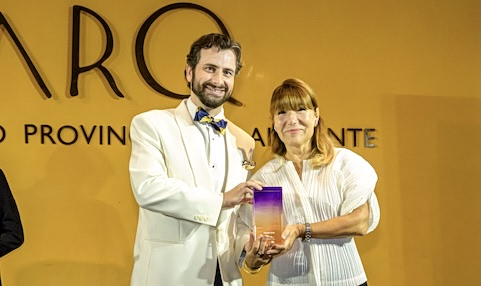
The award, which recognizes institutions that foster critical thinking, inclusion, social justice, participation and community engagement through art, was presented during a special ceremony last month in Alicante, Spain. The Athens museum was selected from six European finalists.
Samuel Gallacher, Chair of the Art Museum Award Jury, praised EMΣT Artistic Director Katerina Gregos and her team for the “authenticity and ambition” with which their vision has been translated into practice. The jury cited the museum’s extensive program of thought-provoking exhibitions and its role in championing Greek contemporary art while maintaining a strong international outlook.
“A champion of Greek contemporary art while confidently outward-facing to the eastern Mediterranean and the world beyond, EMΣT is a much-needed cultural bridge in an increasingly isolated and fractured world,” Gallacher said. He added that the museum’s “quality of production, originality of thought and a heartfelt belief in making a positive impact” had helped it stand out in a highly competitive field.
“EMΣT does not just hope to change the way audiences think about contemporary art, but about their lives and the world in which they live. Their work is now rightly held up as a model for other museums to follow,” he said.
The award comes after a period of significant transformation at EMΣT under Gregos, who has diligently worked to position contemporary art as a platform for critical engagement with some of the most urgent questions shaping society.
“This distinction is particularly meaningful because it recognizes our commitment to exploring the social role of contemporary art and engaging with some of the most important and critical issues of our time,” Gregos said.
“At a time of increasing polarization, I believe museums have a responsibility to create space for critical thinking, different perspectives and difficult conversations, and to demonstrate why contemporary art matters to the world we live in,” she added.
Greek Culture Minister Lina Mendoni said the award marked an important moment for Greek culture and was a significant achievement for EMΣT, its staff and everyone involved in developing its program.
“EMΣT’s international trajectory confirms that Greece is not only a country with a treasured cultural heritage, but also one that generates, supports and promotes contemporary artistic creativity and production,” Mendoni said.
Another Greek Distinction

Greek researcher Angeliki Giannakidou (C), founder and president of the Ethnological Museum of Thrace, receives the Lifetime Achievement Award for her exceptional work from the European Museum Academy in Alicante, Spain, on September 26, 2026.
In addition to the EMΣT distinction, the European Museum Academy awarded Greek researcher and Ethnological Museum of Thrace founder Angeliki Giannakidou with its Lifetime Achievement Award for her important contribution to cultural heritage and museum work.
Based in Alexandroupoli, the Ethnological Museum of Thrace has operated since 2002 in a historic neoclassical building dating to 1899. The self-funded, non-profit institution is dedicated to preserving historical memory and documenting the culture of Thrace from the 17th to the 20th century. Giannakidou founded the museum following four decades of research in the Thrace region. She has dedicated her life to preserving and documenting the traditions, customs, objects, stories, and everyday life of the people of Thrace. Through her work, she has helped keep the region’s rich cultural heritage alive and accessible to future generations.
Mendoni described the museum as “a true beacon of culture” and praised its contribution to preserving and revitalizing the identity and folk traditions of Greece’s border region. “Through its multifaceted activities, scholarly publications, educational programs, and ongoing research into Thrace’s music, ceramics, metalwork, and culinary heritage, the museum has managed to transform historical memory into a living force for creativity and social cohesion,” Mendoni said.