 Μake us preferred on Google
 The written word endures—it always has. Today, however, spoken words endure as well. A simple internet search yields at least a dozen recorded statements by Kyriakos Mitsotakis assuring the public that the elections will take place in the “spring of 2027.” These are words that did not simply vanish into thin air; they were spoken in interviews and speeches, on tours and during public appearances. From the Thessaloniki International Fair (TIF) in 2024, where he first declared his intention (“I intend to serve out my term until the spring of 2027”), to the conference held last week at the Acropolis Museum (“I know repetition becomes tiresome… the elections will be held in the spring of 2027”), the pattern has become as classic as a white wedding dress.
Somewhat paradoxically, the opposition parties are not calling for early elections either. Each has its own reasons for misery. Some are struggling to catch their breath; others are falling apart; one newly formed party simply wants more time—especially now that it is summer, when the leisurely pace of the season is certainly preferable to sweat-soaked speeches before audiences that can be counted on one’s fingers.
Very well—but then why is everyone else discussing the election date? Or rather, why would they still be discussing it even if the fixed refrain of “spring 2027” were announced through a loudspeaker with a sticker pinned to the Prime Minister’s lapel? Why, in the end, is nobody convinced?
One reason is undoubtedly the ambiguity cultivated by the Prime Minister himself. His declared institutional commitment to the constitutional order is consistently accompanied by the fallback option of an electoral surprise. Kyriakos Mitsotakis appears to say one thing publicly while doing—or instructing his government, his party, and his MPs to do—something else, namely to remain in campaign mode even in the middle of summer.
NEWSLETTER TABLE TALK
Never miss a story.
Subscribe now.
The most important news & topics every week in your inbox.
Then there is the circle surrounding him—described as the “Prime Minister’s circle,” though vague both in definition and composition. It consists of supposed insiders, informal interlocutors, and self-appointed advisers who claim—or pretend—to know more than everyone else. This group is portrayed as entering Maximos Mansion through the side entrance and “recommending” various autumn election dates to Mitsotakis, who supposedly “has not yet made his final decision” and “will assess the situation at the end of August.” In this way, the ambiguity is carefully maintained until it is eventually presented as “reliable information” predicting a surprise election announcement at the 2026 TIF—two full years after the 2024 TIF and the first assurance that “the elections will be held in the spring of 2027.”
Those belonging to the Prime Minister’s inner circle, of course, are portrayed as possessing strong opinions and extraordinary predictive powers. Based on their forecast that the coming winter will descend upon us like Armageddon and the Apocalypse combined, they confidently insist that “Mitsotakis will call elections in the autumn to get ahead of the worst.” If they turn out to be right, they will present themselves as political prophets. If they are wrong, they will simply throw yesterday’s certainty into the trash—after all, who remembers what they were saying?
What remains, then, is to invent the “national issue of exceptional importance” provided for by the Constitution as grounds for dissolving Parliament and calling early elections.
That constitutional provision was not originally intended to cover every conceivable political difficulty. Fifty years ago, with the Turkish invasion of Cyprus still fresh in memory, the framers had in mind the possibility of an external national threat. Half a century later, however, the interpretation of the constitutional clause has expanded so dramatically that early elections are now often treated as something resembling a prime ministerial prerogative, broad enough to encompass almost anything except an actual national emergency. A corruption scandal of “exceptional importance,” for example, or a court case of “exceptional importance” that might alter the electoral calculations of Maximos Mansion.
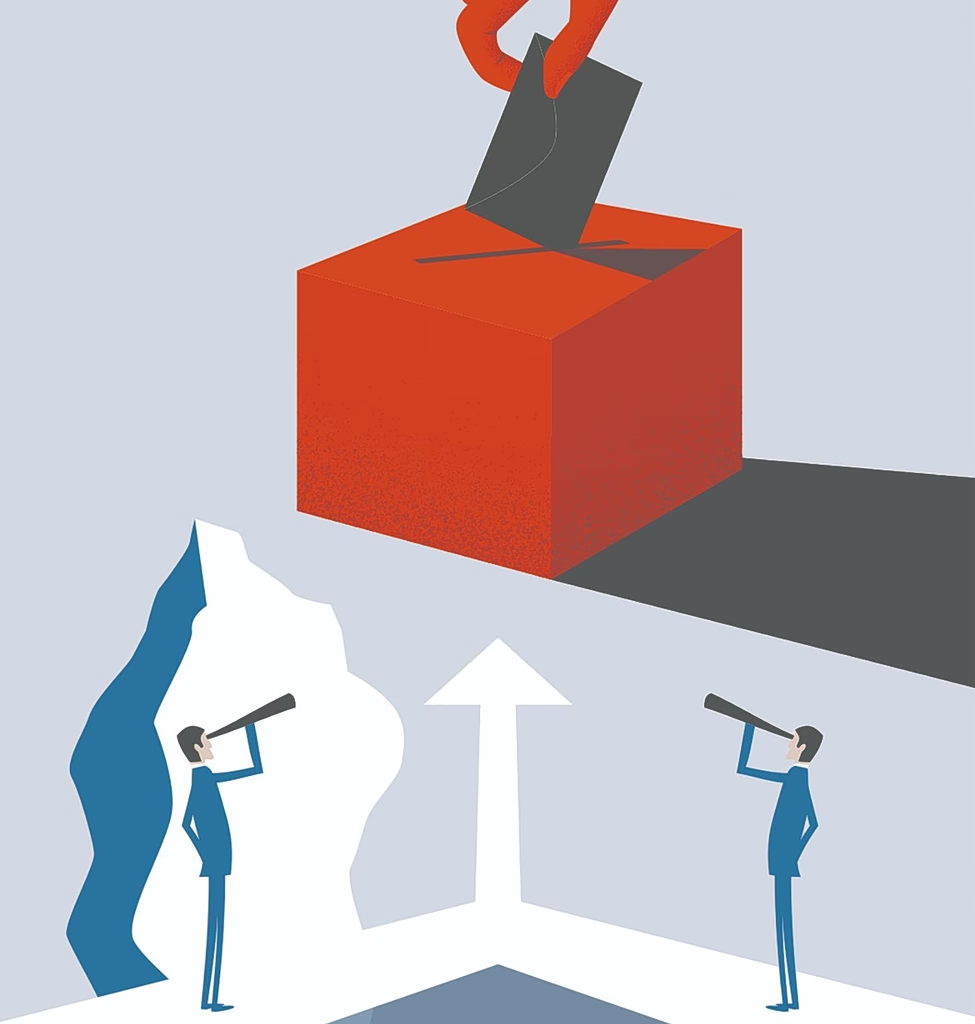
Will the elections be held institutionally, or as a matter of prerogative? From the standpoint of political betting alone, it is an entertaining question.
It ceases to be entertaining, however, because from the government all the way down to the public administration, the country freezes in anticipation of elections and then struggles to regain its footing afterward. It freezes in August and bleeds through autumn, winter, spring—and then summer all over again.