 Μake us preferred on Google
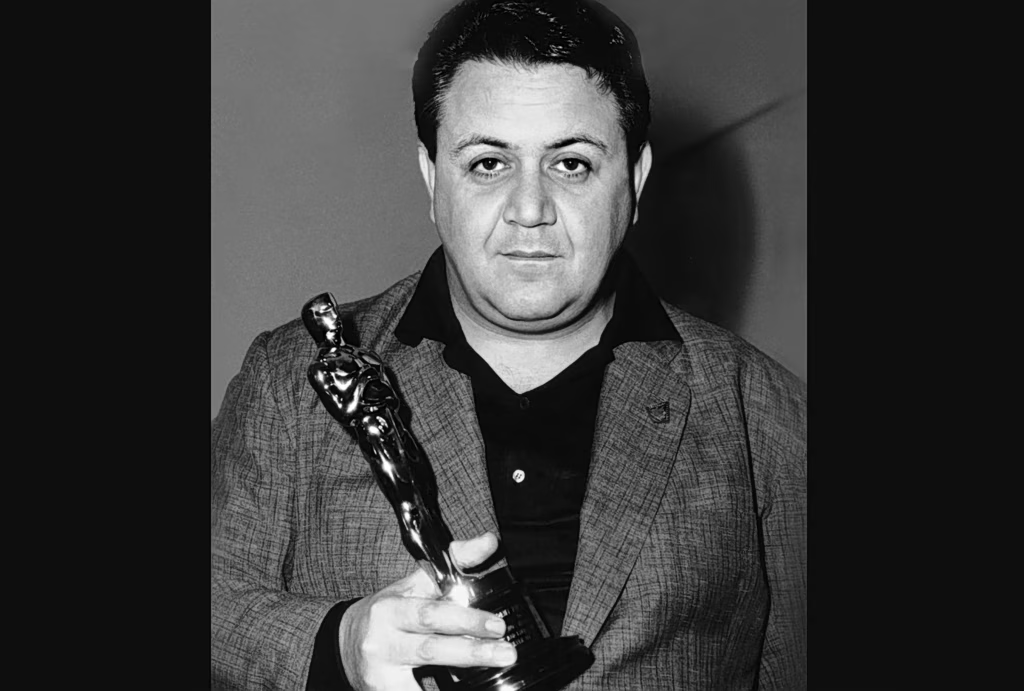
 On April 17, 1961, Manos Hadjidakis was awarded the Academy Award for Best Original Song for “Never on Sunday” (“Ta Paidia tou Piraia”), featured in the film Never on Sunday, directed by Jules Dassin.
As reported by the Greek newspaper To Vima on April 19, 1961, in a dispatch from Santa Monica, California:
“The Greek composer Mr. Manos Hadjidakis was honored yesterday with the Oscar for Best Motion Picture Song of 1960 for his composition ‘Ta Paidia tou Piraia,’ heard in the now widely known film by Jules Dassin, ‘Never on Sunday.’
NEWSLETTER TABLE TALK
Never miss a story.
Subscribe now.
The most important news & topics every week in your inbox.
“The presentation of this year’s Oscars—the most prestigious award in America for achievements in the art of cinema—took place during a magnificent ceremony attended by approximately 2,500 people, including many of Hollywood’s most renowned actors.”
This distinction was not merely a personal triumph. It marked the first time a Greek composer reached such a pinnacle, carrying with him a piece of Greece onto the global stage.
A Nation Moved
The reaction in Greece was immediate and deeply emotional. As noted by the publication “Tachydromos” on April 22, 1961:
“With surprise, but also deep emotion, the music-loving Greek public received last Tuesday the announcement that this year’s Oscar for Best Song in a Film had been awarded to the immensely popular composer Manos Hadjidakis, creator of ‘Ta Paidia tou Piraia’ and so many other well-known songs […]
“The multi-awarded Greek composer—who has already won two first prizes at the Greek National Radio’s Light Song Festivals, the award of French composers for ‘Ta Paidia tou Piraia’ as the best ‘folkloric’ song of the year, the German ‘Golden Record’ for over one million copies sold, and now the Oscar, the highest distinction a composer can receive […]
“This great honor, granted for the first time to a Greek composer, reflects—just as the award winner himself said—on Greece.”
“This Oscar Belongs to Greece”
Hadjidakis himself was quick to frame the award as a collective achievement. In an interview published in “Ta Nea” on April 19, 1961, he said:
“With great emotion I received the announcement that the Motion Picture Academy of Hollywood awarded me this year’s Oscar for Best Song in a Film of 1960.
“I must confess that despite the rumors that I would win the Oscar, I did not expect this honor to be bestowed upon me. Now that it is a reality, I feel extremely moved and happy […]
“Any honor granted to a Greek outside Greece is rightfully received by our country itself, because all true personalities of our land carry with them a large part of Greece in whatever they create.
“That is why the Oscar I won also belongs equally to my country. After all, why did it stand out abroad? Because I create Greek music.”
He also acknowledged an earlier Greek Oscar winner:
“Let us not forget that this great distinction was preceded by Katina Paxinou.”
Paxinou had won the Academy Award for Best Supporting Actress in 1944 for her role as Pilar in For Whom the Bell Tolls.
Staying True to Greece
Despite international acclaim and new opportunities, Hadjidakis remained deeply rooted in his homeland:
“Whatever foreigners may want from me, I will prepare it here, as I have always done. It is impossible for me to be away from my country for long.”
A Vision Beyond the Oscar
Far from resting on his success, Hadjidakis saw the Oscar as a beginning:
“I feel that only now am I beginning my career… and I know that a brilliant start demands an equally brilliant continuation.”
At the time, he revealed ambitious plans:
“In addition to my obligation to compose music for the film ‘The Lion of Sparta’ (a Twentieth Century Fox production), I must complete by the end of the year my first opera, which I have already been working on for a long time.
“I conceived the story myself, while my friend, the poet Nikos Gatsos, wrote the libretto. It is a modern story about my Melissanthi.”
Although the opera he described as his “life’s work” was never completed in that form, Hadjidakis did not abandon the idea. Over time, the material evolved into one of his most distinctive works, “The Great Erotic”—not an opera, but a cycle of songs with strong dramaturgical structure and poetic narrative, reminiscent of a stage composition.