 Μake us preferred on Google
 For centuries, Delos was more than an island. In the middle of the Aegean, it stood at the heart of a maritime network that connected the Cyclades through trade, travel and culture.
That idea lies at the center of photographer Erieta Attali’s new exhibition, Archipelago of Memory | From Delos to the Aegean, which unfolds across four venues on Mykonos and Delos. Rather than treating Delos simply as an archaeological site, Attali uses photography to explore its relationship with the surrounding landscape and the sea that once connected it to the wider Aegean world.
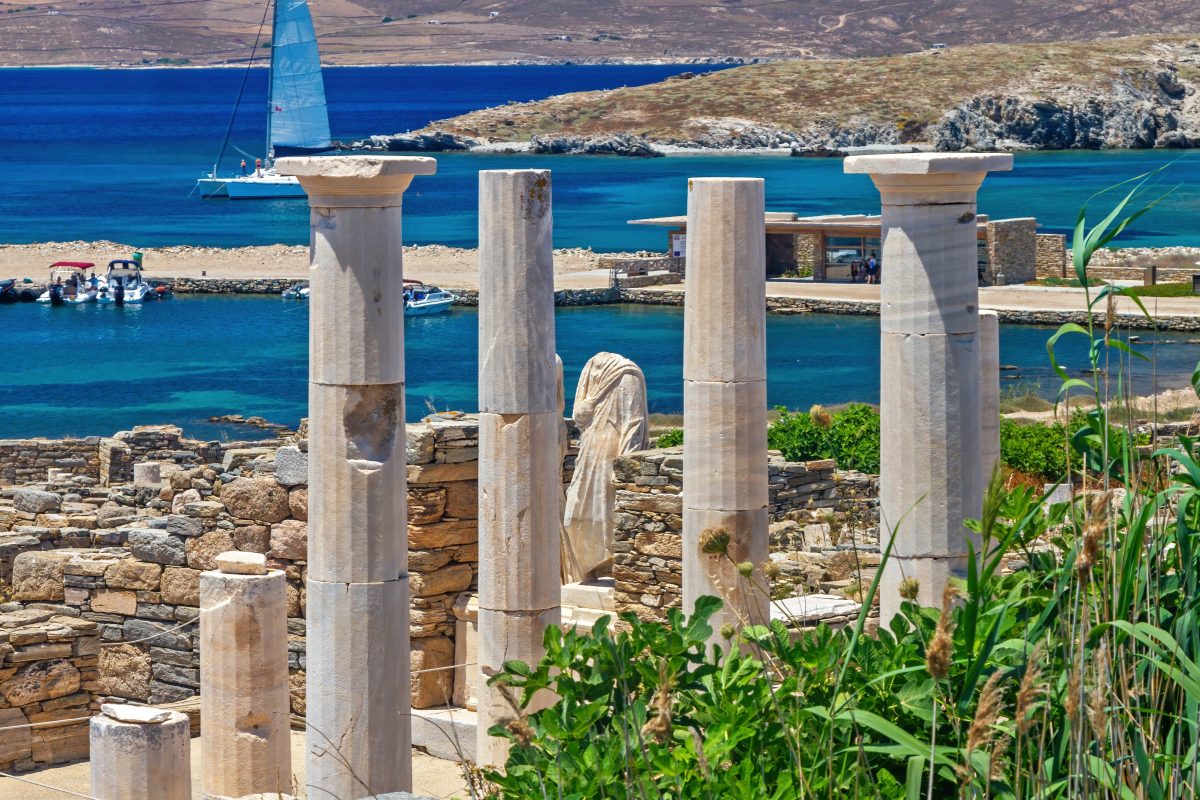
Her images bring together seascapes, ruins, architectural fragments and mosaics, photographed under changing sunlight, moonlight and night skies. The result is an attempt to transform ancient sacred places into what Attali describes as “sacred landscapes of today.”
The exhibition opens August 23 at the Maria Inglesi Municipal Art Gallery in Mykonos, under the auspices of the President of the Hellenic Republic, Konstantinos An. Tasoulas.
Beyond the ruins
In the history of ideas, the “Sublime” refers to an aesthetic experience that suggests something profound and extraordinary—a condition in which a landscape seems to reveal a metaphysical dimension. Since the Romantic era, artists have sought to capture or describe that experience.
Attali’s photographs of Delos and the Cycladic sea engage with precisely this meeting point between spiritual exaltation and aesthetic emotion. A landscape and architectural photographer known for her extensive travels and determined approach to her work, she describes her exhibition as an exploration of Delos and the Southern Aegean through images that tell stories.
When she photographed Delos, one of Greece’s most important archaeological sites and a UNESCO World Heritage Site since 1990, Attali deliberately avoided limiting herself to the scientific documentation of its antiquities.
Her focus was the relationship between the ruins and the landscape around them, the sea that linked the islands and, above all, the idea of Delos as the center of a wider world stretching across the Cyclades and the Aegean.
“My mission is not documentation,” Attali says. “It is conceptual photography based on narrative. And that is how I approach Delos and the Southern Aegean. My images tell stories.”
From archaeological photography to contemporary art
That approach has deep roots in Attali’s career. She began with scientific and archaeological photography, documenting, among other projects, almost all of the Macedonian tombs and working for five years at Vergina, the archaeological site in northern Greece associated with the ancient Macedonian kingdom.
She trained at the British Museum and the Victoria and Albert Museum before moving to New York, where she turned toward contemporary architecture and artistic photography.
Yet the desire to return to antiquity had been with her since the late 1990s.
During a 1999 trip to the Greek island of Milos, she saw ancient settlements and began thinking that she would one day like to photograph ancient cities and remains “embedded in their original landscape.”
That project did not happen then. Attali moved to New York, continued her studies and worked on contemporary architecture. But, she says, she always knew she would eventually return to that original ambition—two decades later.
A decisive step toward Delos came with an earlier major project, her book Periphery: Archaeology of Light, which won the prestigious Gold Award in the German Photo Book Prize 2019/2020 competition.
For that project, Attali studied human-made structures at the edges of the world, from the Arctic and Antarctic to Japan and Australia, searching for the relationship between the periphery and the center.
In her thinking, that “center” was already ancient Greece. Even the book’s cover, she explains, represented the periphery with a circle, while Delos occupied the center.
Returning to the center
After years of photographing oceans, deserts and remote landscapes, Attali eventually reversed her perspective. Instead of looking outward from the periphery, she would return to the center—and look back toward the edges.
The project as it exists today was born almost by accident in October 2022.
Attali had traveled from Paris to Mykonos for her second photographic expedition to Delos. But severe weather grounded ships and airplanes.
“For two days I could not cross over,” she recalls. “From Mykonos I was looking at Delos through the waves, listening to the strong wind, and I realized the paradox: I am so close and so far away.”
The experience changed the way she thought about the project.
She began asking not only how we see Delos today, but how people approaching the island in antiquity might have seen it.
“How did they see the island as they sailed, as they arrived? And, conversely, how did the people of Delos see the other islands from their position at the center of the Aegean?”
The sea, in turn, ceased to be merely a backdrop for the archaeological remains. It became a central element of the story.
In antiquity, Attali points out, seafaring, trade and movement connected the islands. “Delos did not exist in isolation: it was part of a network in which maritime routes determined economic and social life,” she says.
From the island’s highest points, on a clear day, Mykonos, Tinos, Syros, Paros and Naxos can be seen, with Naxos’s high mountains dominating the horizon. Even more distant islands are visible.
“These visual connections are not a detail of the landscape but an essential part of the history,” Attali says.
That is why she photographs the entire island on foot, treating Delos as an archaeological landscape in which “ruins, architecture, archipelago, seascape, layers of history, culture and topography” coexist.
“I did not want to isolate a statue, a column or a building from its surroundings, but to convey the relationship between the ancient city and the geography that made it what it was.”
Delos as a maritime center
In Attali’s photographic narrative, Delos once again becomes a center—not as a static archaeological monument, but as a point of reference within a maritime world.
Her gaze does not stop at the ruins. It moves through them and toward the horizon, toward the other islands that have stood across the sea from Delos for centuries.
That idea also shapes the way the exhibition is presented.
The photographs appear at the Municipal Art Gallery of Mykonos, the Aegean Maritime Museum, the Archaeological Museum of Mykonos and the Archaeological Museum of Delos. Together, the four venues function as a metaphor for the archipelago.
The choice of locations was deliberate. Attali says there is a specific conceptual connection between them that she wanted visitors to experience as they move through the exhibition.
Curated by Attali and Giannis Tournikiotis, the exhibition features large-scale prints of her work. Lambros Papanikolatos coordinated the exhibition’s production in collaboration with Katerina Zouganelli on behalf of the Municipality of Mykonos, while Tasos Roidis handled the architectural design.
Elisavet Tsouchtidis and Aris Bafaloukas were responsible for the design and production of the audiovisual material, while Aris Kafandaris handled the mapping.
Visitors do not, however, have to see all four venues.
“It is of course not necessary to visit all four spaces,” Attali explains. “Each presentation works on its own and is absolutely complete. The basic idea is that of bridging, of creating connections. In this way, I suggest to the viewer, the visitor, that they follow this route—but I do not impose it on them.”
Four spaces, one archipelago
At the Municipal Art Gallery of Mykonos, the exhibition includes 18 photographs addressing the island and Delos’s relationship with the other islands, as well as the reverse relationship: how those islands connect to Delos.
The Aegean Maritime Museum will display seven photographs in its courtyard. Attali says their relationship with the museum’s exhibits is particularly fitting because the museum itself is connected to the sea.
“That is why I chose seascapes for the exhibition,” she says.
At the Archaeological Museums of Delos and Mykonos, Attali will install two particularly important photographs that, she says, come from the “lost island.”
For Attali, these different pieces and locations are ultimately part of a single whole.
“Everything is connected to everything else,” she says. “That is, after all, one of my fundamental beliefs in life: that everything we do is connected. There is no action that is truly detached from the others.”
Exhibition information
Archipelago of Memory | From Delos to the Aegean by Erieta Attali opens August 23 at the Maria Inglesi Municipal Art Gallery in Mykonos, under the auspices of the President of the Hellenic Republic, Konstantinos An. Tasoulas.