 Μake us preferred on Google
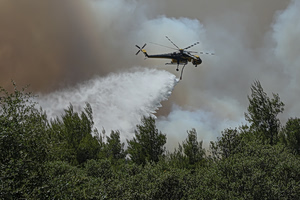
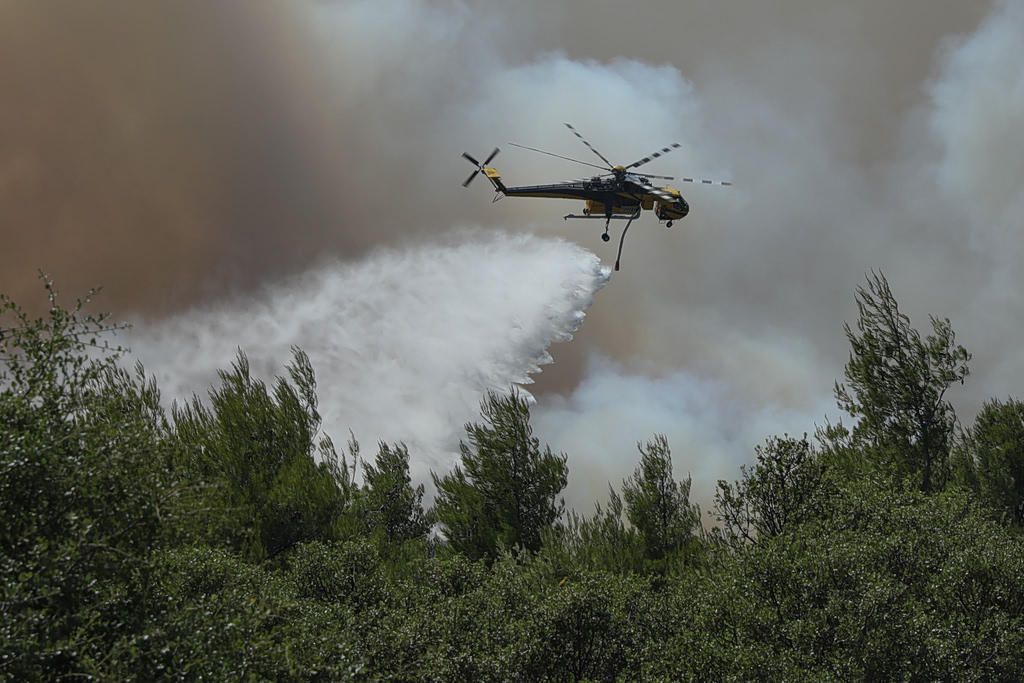
 A fatal midair collision between two leased Bell firefighting helicopters during wildfire operations near Psatha in western Attica has prompted an extensive investigation, with aviation experts cautioning that it is too early to determine the exact cause.
The crash occurred on Sunday, Aug. 2, while the helicopters were battling the large wildfire affecting the Attica-Boeotia region. A Greek aerial operations coordinator and a Danish pilot were killed. The other helicopter’s crew—a Greek coordinator and a British pilot—survived and were taken by ambulance to the 251 General Air Force Hospital for treatment.
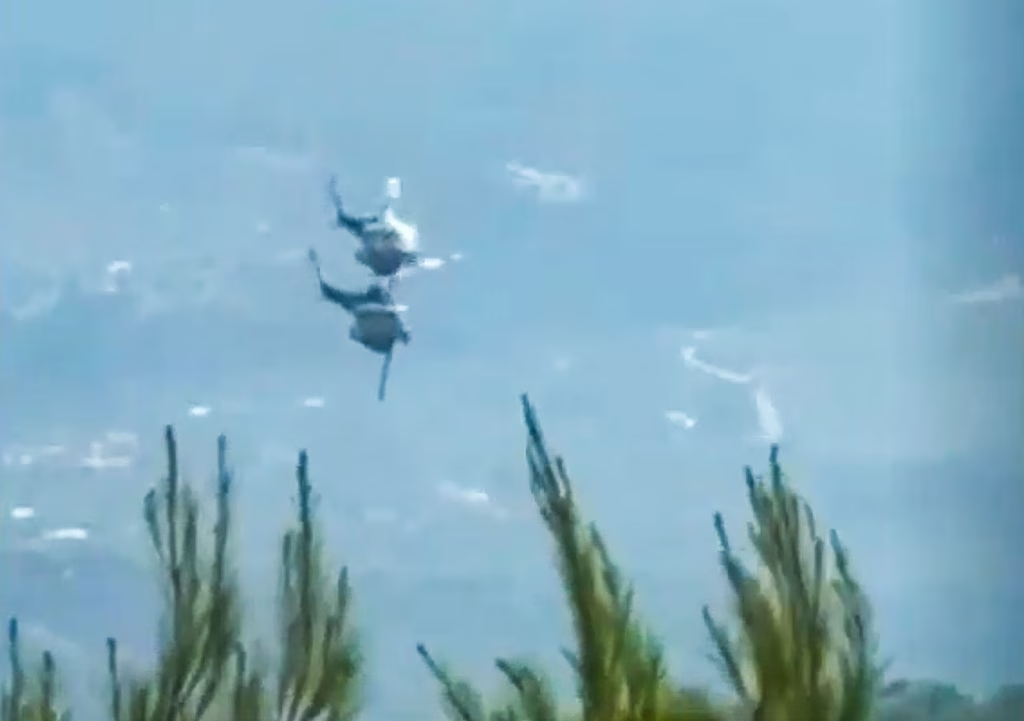
Authorities have also released video footage capturing the moment of the collision above the wildfire.
Fire Service Confirms Investigation
In an official statement, the Hellenic Fire Service said the two leased Bell helicopters collided while conducting aerial firefighting operations.
Search and rescue teams were immediately deployed and recovered all four crew members. The operation was coordinated at the scene by Fire Service Chief Lieutenant General Theodoros Vagias.
The helicopters had taken off from Elefsina Air Base before joining the firefighting mission. The Fire Service said the exact causes and circumstances of the accident remain under investigation by the competent authorities.
Experts Outline Possible Scenarios
Pilot and aviation expert Pantelis Fragkoulis described the collision as a “tragic mistake” and said the video raises serious questions that can only be answered through the official investigation.
He said one key issue is determining the precise role of the second helicopter. If it was serving as an aerial coordination aircraft, he argued, it should not have been operating at the same altitude as helicopters repeatedly dropping water and performing aggressive maneuvers directly over the active fire.
Fragkoulis stressed that no firm conclusions should be drawn until investigators establish the exact missions both crews were carrying out at the time of the collision.
Retired Air Force Lieutenant General Vasilis Vrettos suggested the video indicates that one helicopter was flying at a significantly higher speed and may not have maintained visual contact with the other because it was flying below it. He said the lower helicopter appeared to make a last-second turn, which may have further worsened the situation.
Vrettos noted that collisions between helicopters are uncommon but said such accidents can occur in environments marked by extreme stress, fatigue, and operational pressure.
“The commanders are responsible for ensuring crews fly under safe conditions,” he said, adding that the investigation will determine whether there were coordination failures, inadequate safety measures, or other contributing factors. While human error appears possible, he said other significant causes cannot yet be ruled out.
Loss of Separation Among Key Theories
Aviation accident expert Faithon Karaiosifidis said his initial assessment of the video suggests the two helicopters were not maintaining the required separation distance during flight.
According to his analysis, the trailing helicopter may not have had a clear view of the aircraft ahead after completing a turn. He believes the rotor blades of the second helicopter likely struck the rotor system of the first, causing catastrophic damage.
“Once the rotor system and transmission are destroyed, the helicopter ceases to be a flying machine and falls,” he said. “In such a case, the chances of survival are practically zero.”
Karaiosifidis said investigators are examining several possible scenarios, including human error, strong upward or downward air currents, and mechanical failure. However, he considers it most likely that the pilot of the trailing helicopter temporarily lost visual contact with the aircraft ahead because it was positioned in a blind spot below the pilot’s field of view. Had the danger been detected earlier, he said, the trailing pilot would likely have had more time and space to take evasive action.
Aviation Expert Points to Blind Spots and Lack of Visual Contact
Aeronautical engineer and aviation expert Kostas Lakafosis described the crash as unprecedented in Greece, saying his initial analysis of the available video suggests neither pilot was aware of the other’s presence before the collision.
Speaking to Greek broadcaster MEGA, Lakafosis said the Bell firefighting helicopters involved have significant blind spots because they do not feature fully transparent “bubble” canopies, limiting pilots’ visibility in certain directions.
According to his assessment, the helicopters were not flying in formation. In a standard formation, he explained, the trailing aircraft remains slightly lower and behind the lead helicopter to maintain continuous visual contact. “We have two helicopters converging on the same flight path from different directions, and neither appears to have been aware of the other,” Lakafosis said.
He added that neither pilot appeared to maneuver into a formation, reinforcing the possibility that both crews lost sight of each other before impact.
Lakafosis also emphasized the importance of testimony from the crew of a third helicopter operating in the area, as well as any available radio communications, which he said could prove critical to understanding the sequence of events. He noted that Greece’s aviation accident investigation authority is expected to examine those elements as part of the investigation.
According to Lakafosis, a Fire Brigade coordination helicopter, identified as FLOGA 1 (a BK 117 helicopter), was also operating over the fire. However, he said an airborne coordinator cannot continuously maintain visual awareness of every aircraft involved in a complex firefighting operation.
He further suggested that at the moment of impact one helicopter was flying above the other, with the lower aircraft positioned beneath the upper helicopter’s fuselage—an area where visibility is limited for both pilots.
Lakafosis also noted that the Bell helicopters are certified for single-pilot operations. While that is permitted, he said it is not necessarily the safest configuration, explaining that larger helicopters with multi-person crews benefit from additional personnel who help maintain situational awareness and monitor surrounding traffic. In single-pilot operations, the second occupant primarily assists with radio communications rather than serving as an operational flight coordinator.