
 Μake us preferred on Google
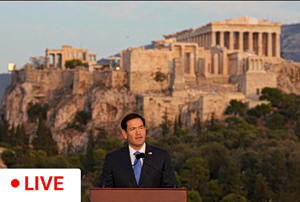
 Can a city function without the private car? And what will Athens look like in 10, 15, or 20 years if owning a car stops being a necessary part of daily life? The question was raised in the discussion “A City Without Cars: Can It Exist?”, part of ΤΟ ΒΗΜΑ’s conference “Dialogues for Athens: From Myth to the Modern City,” with Kent Larson, Professor of the Practice at MIT and head of City Science at the Media Lab, and Panayotis Tournikiotis, professor emeritus at the National Technical University of Athens. The discussion was moderated by former Athens Mayor Kostas Bakoyannis.
For many people, the car still means freedom, independence, and the ability to organize their daily lives without depending on others. The idea of a city without private cars, therefore, is not only about transportation. It is about how children get to school, how workers get around, how independent older people are, and how much space is left for walking, pausing, and social life.
The first question put to Kent Larson was whether such a future is truly possible. His answer was clear: it is entirely possible, as long as the right alternatives are in place.
As he explained, if residents are asked to give up their private cars, the city must be able to offer them a different system for daily travel. That means housing close to work, schools, stores, and basic needs, along with excellent public transportation and complementary mobility services.
At the heart of this change is the shift from ownership to access. Instead of a private vehicle that sits parked for most of the day, residents could use shared vehicle fleets, called on when there is a real need to travel.
“If you are going to encourage people to give up their private car, you have to give them alternatives,” was the MIT professor’s main argument. The solution, he said, must serve people of every age, income, and ability, so that a city without private cars does not become the privilege of a specific social group.
Autonomous Vehicles Are Changing the City
Technology is expected to play a decisive role in this transition. Kent Larson described his experience in San Francisco, where he uses Waymo’s autonomous vehicles. As he noted, he has found that even professional drivers may consider autonomous vehicles preferable, as they are more predictable and safer.
Based on how the technology is developing, the MIT professor estimated that within 10 to 15 years, cities could begin to ban or restrict human-driven vehicles, at least in their central areas.
According to him, this development is likely to affect cities like Athens as well. The scenario is not a city without vehicles, but a city in which human driving and private car ownership are no longer the main form of mobility.
The discussion thus shifts from the question “how do we make cars disappear?” to “what kind of mobility do we want when the private car is no longer necessary?”
From Doxiadis’s “Anthropopolis” to Zenetos’s Electronic City
For Panayotis Tournikiotis, the discussion about a city without cars is not new. Instead, it is connected to a series of ideas about the future of the city that at times seemed utopian.
The NTUA professor emeritus referred to Konstantinos Doxiadis and the idea of “anthropopolis,” a city in which people could meet their basic daily needs within about a ten-minute walk, while still being able to use a car when necessary.
A few years later, Takis Zenetos proposed his own version of the city of the future through the idea of the “electronic city.” Technology would allow people to communicate, work, study, or take care of their needs from home, reducing the need for daily travel.
What once seemed like science fiction became, to a large extent, reality during the pandemic. Tournikiotis cited the National Technical University of Athens as a telling example, where teaching shifted from in-person to online within a single week.
According to him, this example shows that the limits of what is possible in a city can change very quickly when conditions and technology change.
The challenge for the next 20 years, therefore, is not simply to imagine a city without private cars. It is to answer what will replace them and what the new form of mobility will be.
Public Space Does Not Belong to Cars
In this discussion, public space takes on central importance. Tournikiotis stressed that public space belongs to everyone and that changing the city requires, first of all, a change in how its residents themselves understand space.
Mobility, he noted, is connected to destination. People travel to work, study, and take care of their needs, but also to have fun and make use of their free time. Therefore, the city of the future should not be designed solely around the need for residents to move quickly from one point to another.
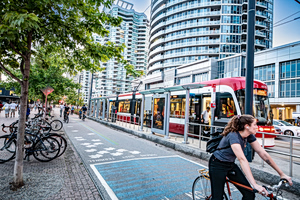
Public transportation will remain a key pillar, while forms of micromobility will grow. Bicycles, scooters, and other small vehicles can play a complementary role, especially for shorter distances.
The NTUA professor also referred to new forms of air mobility and drones, estimating that the technology could advance significantly over the next decade. He remarked that he could be using a drone to get to the university in 10 years, not 20.
From Streets for People to Streets for Cars
Kent Larson went back to the history of the city to explain how we arrived at today’s situation. He referred to the early 20th century, when streetcars began entering cities and streets were still, above all, a space where people coexisted. Photographs taken from cameras mounted on the front of streetcars, he said, show a street that looked more like the city’s “living room”: people walked, met, and socialized in it.
This picture began to change drastically in the 1950s and 1960s, when streets were increasingly designed around the needs of machines. They became not only corridors for cars to pass through, but also places to store them for most of the day, when they are not in use.
For Larson, today’s technological progress creates an opportunity to reverse this course. Autonomous vehicles and shared mobility services can reduce the need for private cars and, as a result, free up public space for people.
The change, however, is not only about cars. In the future, he estimated, there will be a wider range of micromobility options, from small vehicles for one or two people to small buses and mobility services that can serve families without the need to own a private car. All of these should complement a strong mass transit network connecting different neighborhoods.
Amsterdam and Copenhagen as Examples
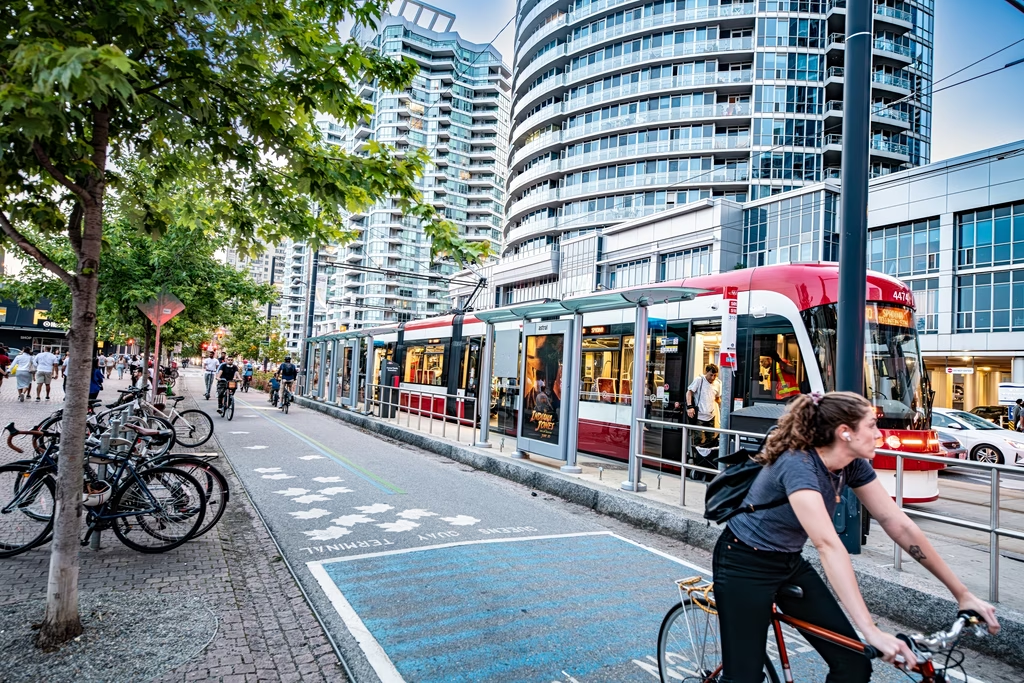
As examples of cities that have taken significant steps in this direction, Larson pointed to Amsterdam and Copenhagen, where cycling infrastructure has developed considerably.
Even more important, however, he considers the change in the culture of how streets are used. On many streets in these cities, priority belongs to people. Cars do not disappear, but they move more slowly and with greater respect for pedestrians, as the street is treated as a shared space.
According to Larson, this approach could be applied even more widely once vehicles become autonomous and can be programmed to follow specific rules. On a busy street, for example, they could move very slowly and carefully during the day, while at other times adjusting their speed to traffic needs.
The goal, therefore, is not only for the city to decide which vehicles are allowed on its streets, but also what behavior it requires of them. Autonomous vehicles, according to the MIT professor, should act like “good citizens,” with rules that put people first, not vehicles.
“We Don’t Share Public Space, We Use It for Parking”
Panayotis Tournikiotis approached the issue from the perspective of urban planning, rejecting the idea that the shared city is a utopia. As he stressed, the problem is not machines themselves. The real “machine” is the way people think and understand shared space.
At the center, then, is the very perception of public space. The professor referred to the concept of “life between buildings” and to the need to treat the space of everyday life as truly shared.
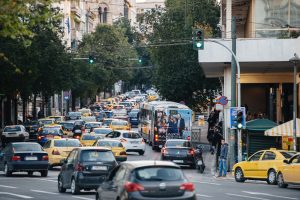
Athens, he observed, is far from that picture. A walk through the city’s streets, especially away from the main central avenues, is enough to see that much of them has been turned into parking space. “We don’t share public space, because we use it to park our cars,” was essentially his argument.
The first step, therefore, is to remove cars from that space. And this, in turn, requires residents themselves to be willing to reduce their dependence on them.
Tournikiotis focused in particular on the change that took place in Athens after the 1980s, when owning two or even three cars per family became common so that family members could travel freely every day.
Electric mobility may address the issue of emissions, but it does not solve the problem of space. An electric car still takes up the same road when moving and the same space when parked. That is why, he argued, the discussion must also address the number of cars each family owns.
Reducing the private car fleet could lead to a corresponding reduction in parking needs and free up space for other uses. If there are fewer cars, there can be more space for pedestrians, bicycles, trees, and public transportation.
The same applies to sidewalks. As he noted, while everyone asks for more and better sidewalks, in practice much of the available space is taken up by parked cars. Removing them would allow sidewalks to be widened significantly and create a different kind of public space, with more greenery, cycling infrastructure, and better connections to rail transit.
For the NTUA professor emeritus, then, the issue is not technically impossible. It mainly requires a more rational choice about how many cars a family really needs and how much space the city is willing to keep giving them.
From Ownership to Mobility as a Service
Kent Larson then raised a different dimension of the discussion: there is no need, he said, to limit people’s ability to travel, but rather to expand the options available. The core idea is to treat mobility as a single service that people can access through one app.
Through the same digital environment, they could access the metro, buses, bicycles, driverless taxis, and a range of other options. Even a car could remain available when it is truly needed, but without being permanently owned.
“I’m not talking about science fiction. I’m talking about pragmatism,” he stressed, describing a model in which no one needs to have a car parked outside their home every day. If, for example, someone wants a four-wheel-drive vehicle for a weekend in the mountains, they can rent it for as long as they need it. If they want to take a different trip with friends, they can choose a different car. If they need a larger vehicle to carry purchases from a store, they can access one without having to own it.
The car, in other words, does not disappear. What changes is the citizen’s relationship with it. There could be an organized space, even underground, where different vehicles are available and residents choose each time the one that fits the needs of that specific trip.
“I don’t need a car every day,” was Larson’s reasoning. What is needed is the ability to use a car when it is truly necessary, without daily life being organized around owning one.
Young People and the “Outdated” Idea of the Car
He argued that this change may also come through a generational shift. He noted that he recently asked about 30 MIT students how many of them own a car. Only one, he said, raised a hand. When he asked how many expect to own a car in the future, no hands went up.
The students live in a city where they can open their phone, call a mobility service, and within a few minutes have a vehicle arrive to take them to their destination. They do not need to think about parking, or pay for buying, insuring, and maintaining a car.
For this generation, Larson noted, the idea of car ownership may seem more like a habit of previous generations than a necessary part of daily life.
He admitted that it was not always this way. When he turned 16 and got his driver’s license, he too was strongly attached to the car. He believes, however, that as mobility services become more widely available, more and more people will choose not to own a car.
This change, according to the MIT professor, must also be supported by cities. Not only through technology, but also through infrastructure and public policy. Cars, he stressed, remain parked about 95% of the time, which makes the use of public space inefficient.
That is why cities should invest in bike lanes and sidewalks and create the conditions for alternative forms of mobility to become truly functional. The market, social and generational changes, and informed public policy can, in his view, work together and speed up the transition.
“Draw People In, Don’t Push Them”
The change, however, is not easy. Kostas Bakoyannis raised the issue of the resistance seen in many cities, from Paris, London, and Lisbon to Athens, as residents often find it hard to give up daily habits, especially when alternative mobility infrastructure is inadequate.
Larson acknowledged that resistance to change is part of human nature. People push back when asked to change the way they use their space, whether it involves housing, parking spaces, or any other established habit.
That is why, he argued, cities should not try to impose change abruptly. Instead of “pushing” residents, they should create the conditions that lead them to choose the new solutions on their own.
Not owning a car should simply become easier and more convenient than owning one. This requires housing close to workplaces and basic services, walkable neighborhoods and, above all, reliable alternative mobility services for cases where walking or public transit is not enough.
For Larson, a large part of the solution ultimately lies in land use policy and urban planning. Better spatial organization and appropriate land uses can encourage more compact neighborhoods, where residents can live, work, and have fun within shorter distances.
At the same time, cities should invest in alternative mobility systems, so that even when someone needs a motorized vehicle, they have options that are easier to use and more practical than owning a private car.
The question, then, is not only how to persuade people to give up the car. It is how to design a city in which choosing not to have a car is so easy that, in the end, it takes no special effort at all.
Change Is Not Only Planned, It Matures
For Panayotis Tournikiotis, change in the city is partly the result of planning, but to a large extent it comes when social conditions mature and people themselves are ready to accept it. The task for planners and politicians is to recognize the spirit of the times early and adapt to it.
As he noted, people’s relationship with the private car is still strong, but more and more of them realize they can get around in other ways. This change, however, does not happen automatically. The ground needs to be prepared so that alternatives are truly available.
He connected this process to society’s changing attitude toward the environmental and climate crisis. Issues that seemed distant a few decades ago are now part of everyday conversation. The experience of extreme weather events, floods, and overheating cities has led to a different understanding of how urban space should be designed.
That is why, he argued, politicians and decision-makers must remain constantly alert, so they can understand what is changing in society and act at the right moment.
From “Smart Cities” to the Holistic City
The discussion then moved from the car to the broader question of how the city of the future should be designed. Kent Larson expressed reservations about the many different “labels” used in recent years, from green and sustainable cities to smart and human-centered cities.
Instead of tackling each problem piecemeal, he argued for holistic planning of a city that is more livable, economically dynamic, and efficient. Sustainability, he explained, cannot be treated in isolation from social and economic conditions. Its original goal was precisely to balance the needs of the present with those of the future.
Larson said he is nonetheless optimistic about the future of cities. In his view, cities are already the main centers of economic activity and wealth creation, while most of the planet’s population growth is expected to take place in them.
He placed particular emphasis on the role of mayors, whom he described as closer to residents’ real needs and more willing to experiment with new solutions. He did not hide his preference for a world that functions more as a network of cities than solely as a system of nation-states, since, as he said, mayors are often closer to the real changes taking place in society.
As an example, he mentioned his work with San Francisco’s new city administration and Mayor Daniel Lurie on issues related to zoning, housing, and mobility. Technology, according to Larson, can accelerate major changes not only in transportation but also in housing production and in how government functions, with more feedback mechanisms that allow cities to adapt continuously, almost like a natural ecosystem.
His optimism, however, does not mean he ignores the contradictions that characterize modern cities. The same cities that drive economic growth and serve as laboratories of democracy are also centers of social inequality and intense socioeconomic pressure.
San Francisco, as was mentioned in the discussion, is a clear example, with its homelessness crisis remaining particularly severe. Larson argued that tackling such problems requires addressing their root causes and not only their symptoms. In many cases, he said, the lack of access to affordable housing is at the core of the problem, while for part of the homeless population, mental health issues are also involved.
“Not One Big Plan, but Many Plans Working Together”
Asked whether the city of the future needs one large, unified plan or a series of smaller interventions, Panayotis Tournikiotis came out in favor of the second approach.
The era of large, comprehensive plans has largely passed, he said. The future may emerge through many smaller plans and interventions, which may be fragmented but should work together and gradually create a new picture of the city.
In the case of Athens, removing cars is not only about streets and parking spaces. It also concerns the spaces created beneath apartment buildings to house cars.
Reducing the need for private parking could open a new discussion about reusing these spaces. Underground or other spaces now used exclusively for parking could, in the future, be turned into green spaces, playgrounds, micromobility infrastructure, or other shared uses.
According to Tournikiotis, this could create a more “porous” city, in which the boundaries between private and public space are less absolute. The back courtyard of an apartment building, shared spaces, wider sidewalks, and streets can complement one another, creating more opportunities for social life.
The city, therefore, does not need to be designed only through new buildings and major infrastructure. The rules governing how existing space is used need to be redesigned.
“The Same Street, Different Throughout the Day”
One of the most interesting proposals raised in the discussion was the idea of the “dynamic street”: a street that does not have the same use throughout the day.
In the morning, a street could serve deliveries and traffic, later become a mixed space where vehicles, bicycles, and pedestrians coexist, and in the evening give more of its space to restaurants, bars, and pedestrians. On weekends, the same infrastructure could be used differently, depending on the city’s needs and activities.
This approach is not only about building new spaces, but about “inventing” a different way of life in the city. The same street can have different users at different times and on different days, instead of remaining tied to one single function.
“Design for Change”
Asked what the single priority for the next five years could be, Tournikiotis referred to the idea of “superblocks,” meaning areas where traffic is allowed, but under specific rules.
Cars would be able to enter and reach residences, but at very low speeds and with priority given to shared space. Technology can allow these rules to be applied through geofencing, meaning digital boundaries that automatically impose specific driving conditions in an area.
The same approach could also apply to bicycles, so that different road users adjust their speed and behavior according to the space they are moving through.
Kent Larson, for his part, gave a different but complementary answer: “design for change.” In his view, traditional top-down urban planning often fails because it is static. A master plan designed for a specific moment in time may not meet the needs of a city that changes much faster.
That is why, he argued, the city must be approached neighborhood by neighborhood. Cities can be a network of highly functional neighborhoods, where planning focuses on people’s daily lives and not only on major infrastructure.
The discussion “A City Without Cars: Can It Exist?” thus ended not with the image of an Athens without vehicles, but with a different idea of the city: an Athens in which the car is one of the available options and not the measure by which all public space is organized.
The goal, in the end, is not for the car to disappear, but for it to stop being necessary. For residents to be able to walk, use public transportation, a bicycle, or a shared vehicle and, when they truly need it, have access to a car without having to own one.
This requires technology, infrastructure, different urban planning and, above all, a change in mindset. But, as was the shared message of both speakers, the change is no longer a theoretical possibility. It is already underway. The question for Athens is whether it will keep up with it and shape it for the benefit of its residents.