 Μake us preferred on Google
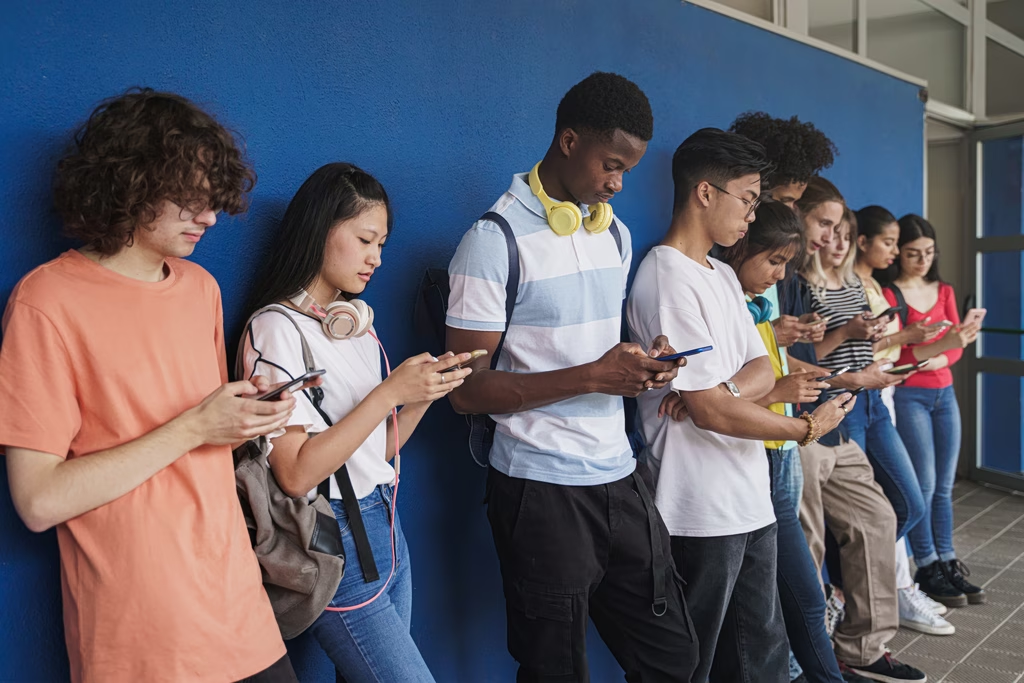
 Greece plans to introduce a 15-year minimum age for social media access from January 1, 2027, Digital Governance and Artificial Intelligence Minister Dimitris Papastergiou said.
The minister said the government intends to legislate the age limit while aligning its approach with the emerging European framework for protecting children online.
A central element will be age verification, with Greece’s existing Kids Wallet system designed to confirm whether a user is above or below a particular age threshold without revealing their date of birth or other identity information.
What happens to users ages 13 to 15
Papastergiou said the European approach for children between 13 and 15 allows access to some social media platforms, but with significant restrictions.
Under the approach he described, children in this age group would not have personal accounts and would be subject to nighttime restrictions, a maximum of one hour of use per day and protections against endless scrolling.
Papastergiou said Greece’s approach on both the age of digital adulthood and age verification had significantly influenced the European discussion and the proposal for the EU Kids Act.
He said Greece needs to introduce its own legislation because the European initiative will take several months to move from an announced proposal to formal EU legislation.
“We should and can legislate — Europe does not prohibit this — and, in fact, we should legislate in a way that is compatible with what Europe has said,” Papastergiou said.
How age verification will work
The minister said social media platforms will bear responsibility for determining users’ actual ages.
Platforms should use the algorithms they already employ to assess whether a profile appears to belong to someone under 15, he said.
“They should use the already intelligent algorithms they have, which in most cases can understand that your profile and mine are not the profile of a 15-year-old,” Papastergiou said.
He added that platforms could similarly identify profiles that appear to belong to younger children.
When platforms cannot establish an age with reasonable certainty, they can use the Kids Wallet, which Papastergiou said Greece has already implemented and which is also among the tools proposed at the European level.
The system does not return a user’s date of birth or other identity information. Instead, it provides only an indication of whether the person is above or below the relevant age threshold.
Parents and schools also part of the plan
Papastergiou said the government also plans to focus on communication with teachers, schools and parents.
He said the issue had been raised in the Cabinet, with emphasis on the importance of going into schools to speak with teachers and educators and, particularly, with parents’ associations and parent groups.
The minister said that from Jan. 1, 2027, Greece will also participate more actively in the European process, which is expected to address both social media and artificial intelligence.
How the EU rules would apply to foreign platforms
Papastergiou said Greece’s measures will rely on the EU’s Digital Services Act (DSA) when dealing with platforms that are not headquartered in Greece.
The DSA already provides penalties for various types of violations, he said.
Under the procedure, Greece’s competent authority, the Hellenic Telecommunications and Post Commission (EETT), can report a case involving, for example, a 14-year-old accessing a social media platform to the relevant authorities in another EU country.
Papastergiou said this is particularly relevant because many major social media companies are headquartered in Ireland. Once the issue is reported, Irish authorities would initiate the procedures provided for under the DSA.
He said discussions are continuing over whether the process for imposing fines could eventually be brought closer to Greece, but that for now the existing DSA procedure will apply.
Age limits alone will not solve social media addiction
Papastergiou also warned that an age limit by itself will not address the problem of social media addiction.
He said adults theoretically have greater capacity to develop mechanisms of self-control and self-regulation, allowing them to recognize when their use of social media is becoming harmful.
“For children, this is not a given,” he said, arguing that the mechanisms involved are more malleable in a child’s mind.
The minister also said parents need to examine their own behavior before setting rules for their children.
“Children essentially watch us and do what we do,” he said. “So I think we should first look in the mirror and then go to our children and tell them anything.”