
 Μake us preferred on Google
 Health Minister Adonis Georgiadis on Friday unveiled MedWatch, an artificial intelligence tool that scans doctors’ and clinics’ online activity for signs of unauthorized or misleading medical practices, saying it would be deployed immediately across all licensed practices in Athens and extended nationwide within about 10 days.
The rollout follows the death of Greek singer Giorgos Mazonakis, whose case exposed how little scrutiny Greece’s private health sector faces and put pressure on the government to act. Georgiadis presented the system alongside Matina Pagoni, head of the Panhellenic Medical Association, and Giorgos Patoulis, president of the Athens Medical Association.
How MedWatch works
Georgiadis said the tool, developed with the help of AI, cross references doctors’ public statements, social media posts and any online mentions of their work with the licenses they actually hold, to flag possible mismatches. The platform is designed to run continuously rather than as a one time sweep, automatically triggering a review whenever it detects a potential violation.
Yiannis Doxaras, who presented the system’s mechanics, said MedWatch pulls data from medical association registries, Google Maps and Google Places, clinics’ own websites, advertisements running on Meta, TikTok and Google, and doctors’ public profiles on Instagram, Facebook and TikTok, as well as platforms that connect doctors with patients. Each claim or advertisement is matched to a specific doctor or business and then checked against that person’s specialty, license and the type of facility where a given procedure is legally allowed to take place, distinguishing, for example, what a dermatologist may do in a standard office from a procedure that requires a surgical unit.
The system sorts findings into 11 categories, including breaches of professional ethics, procedures performed at a facility not equipped for them, practicing outside one’s specialty, inaccurate medical claims, misleading promises and improper drug advertising. Entities are then color coded red, yellow, green or gray. Doxaras cautioned that a red flag does not mean that a facility is confirmed to have broken the law, only that the system found something worth an inspector’s attention; the actual determination still requires an on the ground or administrative check by the relevant authority. The tool also flags patient testimonials used to imply guaranteed outcomes, citing unsubstantiated claims of success on the first attempt at in vitro fertilization as one example.
The reviews extend beyond doctors’ offices to businesses such as aesthetic institutes, wellness centers and spas that advertise medical procedures, as well as corporate entities and digital platforms in the sector.
Early findings
Georgiadis said the ministry had already screened close to 9,000 health-related profiles and flagged about 200 for possible violations. Doxaras, presenting the system in more detail, put the number of facilities screened at around 8,500, with about 50 clinics and 160 non-medical businesses marked red and roughly 400 more given a lower-severity yellow flag. The discrepancy between the two figures was not explained at the briefing.
A second tool and a longevity medicine panel
Georgiadis said a separate consumer facing app was already in development and would be ready for public release within a month. It would let people verify a doctor’s license before an appointment and file an electronic complaint afterward if something went wrong. He said the month was needed in order to ensure the app complies with data protection law.
The minister also announced a new committee to review the legal framework around regenerative medicine, wellness and longevity services, an industry he said was expanding rapidly worldwide. Its members are expected to include Pagoni, Patoulis, representatives of the National and Kapodistrian University of Athens and scientists with experience in medical tourism. Georgiadis said the goal was to identify legal gray areas and legislate where necessary, but stressed that Greece was not trying to restrict the longevity sector, saying such services should instead operate in an organized, transparent and safe manner.
Defending the oversight system
Georgiadis pushed back on criticism of the current inspection framework, saying the former Health and Welfare Services Inspectors’ Corps, was not abolished but had its duties transferred to the National Transparency Authority in 2019. He disclosed that discussions were already underway inside the government about creating a dedicated inspection mechanism within the health ministry itself, saying it had not always been straightforward to trigger targeted checks through the transparency authority given its broad mandate and heavy caseload.
He also defended the role of the medical associations, rejecting accusations that they had allowed misconduct to go unpunished, saying they conduct inspections, pursue disciplinary cases and issue fines. The Helath Minister claimed no single mechanism can continuously monitor tens of thousands of practices and that inspections are often triggered by complaints, noting that no complaint had ever been filed against the Kolonaki clinic where Mazonakis was treated before his death. According to Georgiadis, that is the gap that MedWatch is meant to close by surfacing possible violations even without a prior report from the public.
Pagoni lamented the difficult position the medical profession has found itself in, describing a “feeling of having to apologize because some unscrupulous colleagues did what they did.” She urged patients to learn who their doctor is and what their specialty covers, rather than choosing a practitioner based “on a recommendation from a hairdresser or a friend,” and to seek a second opinion when in doubt. Her appeal to patient vigilance comes even as the Athens Medical Association’s own four inspections of the Kolonaki clinic had not caught on to the plasmapheresis machine now under scrutiny. She also called on the associations’ disciplinary boards to rule on misconduct cases more quickly, and welcomed the new digital oversight of private clinics and medical advertising.
Patoulis described MedWatch as a fast way to identify “red lines” in medical advertising and online health services, saying about 16,500 clinics operate daily in Athens alone. He said the Athens Medical Association has carried out more than 8,780 inspections since 2021, covering new clinic openings, changes in operations, complaints and random spot checks, and cautioned that isolated bad actors should not be allowed to tarnish the reputation of the wider medical profession.
The case behind the reforms
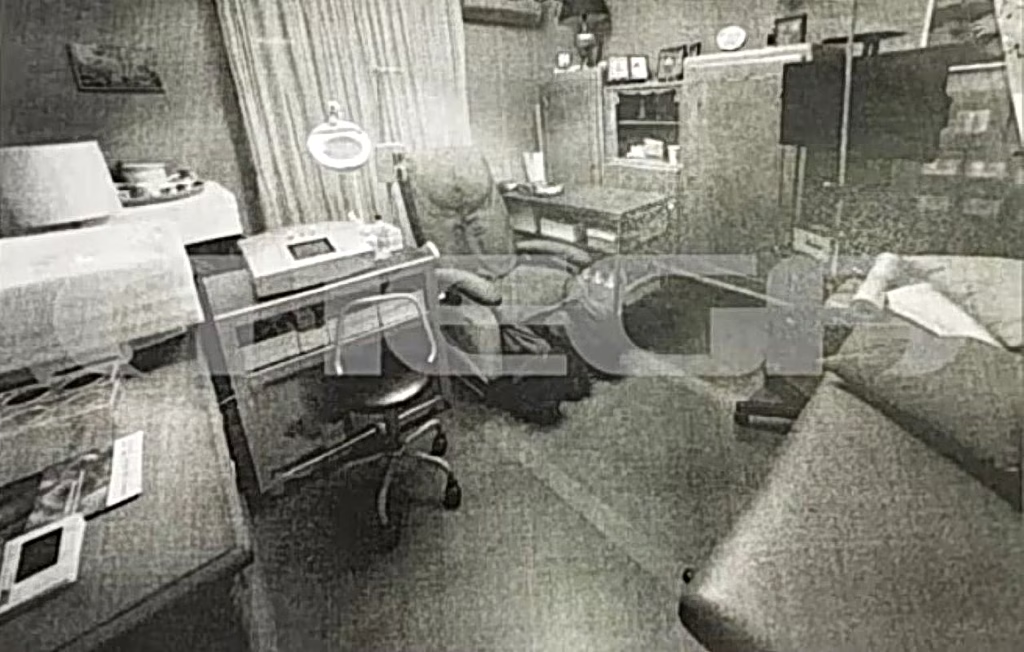
Mazonakis died after treatment at a clinic on Karneadou Street in Kolonaki, an upscale Athens district. Prosecutors ordered an urgent preliminary investigation into whether the Athens Medical Association and the National Transparency Authority bear any responsibility for not catching problems sooner. Records show the clinic was inspected four times, once in 2024 and three times in 2025, without inspectors finding a plasmapheresis machine, a device used to filter blood plasma that is not standard equipment at a general practice. Two complaints were filed with the Athens Medical Association in 2025 by nephrologist Christos Iatrou over a kidney patient who had reportedly undergone the procedure repeatedly at the clinic. Investigators are said to have obtained an invoice showing the clinic purchased a plasmapheresis machine for about 29,000 euros, along with inspection reports lacking official protocol numbers. A second clinic tied to the case, on Patriarchou Ioakeim Street, was found during an inspection to have an unauthorized sauna, which was ordered removed.
The case has drawn renewed attention to the National Transparency Authority’s inspection record since it absorbed the former inspectorate’s duties in 2019. According to reporting by Reporters United, the authority has since carried out only about 80 inspections of clinics, dialysis centers, private hospitals, diagnostic centers and mental health facilities nationwide over those seven years, a rate of fewer than a dozen a year.