 Μake us preferred on Google
 Every summer, when Greece becomes almost unbearably hot, my wife Helga and I spend a few weeks in Mannheim, in southwestern Germany, staying at her family home. Usually, the weather there is considerably cooler. This year, that calculation did not quite work out. But that is another story.
This story is about a soccer team – one that embodies the transformation of Germany’s Greek diaspora over the decades and, in its own modest way, is making a remarkable statement about identity, integration and belonging.
It is one of those sweltering August days. Germany is suffering through a heat wave. Newspapers report heat-related deaths, politicians are calling for emergency measures. I spent my Sunday morning at a sports complex in Neckarau, a district of Mannheim. On the green artificial turf, two teams are battling for goals and victory in a friendly match between TSV Neckarau and SV Enosis Mannheim.
It was the club’s Greek name that brought me here.
My philhellenism means that wherever I happen to be, sooner or later I start looking for Greeks — and for opportunities to talk with them. Mannheim offers plenty of both.
This traditional industrial and commercial city in southwestern Germany, with a population of roughly 320,000, is exceptionally diverse. Labor migration has shaped Mannheim since the 1950s and 1960s, and Greeks were among the early arrivals.
According to the city, 4,291 people with ties to Greece were living in Mannheim at the end of 2025. That figure includes Greek citizens as well as naturalized Germans and their children with a Greek immigrant background. Greeks rank ninth among the city’s nationality and immigrant communities.
Over the decades, this diaspora has left its mark on Mannheim in many ways. Exploring those traces became one of my projects during these summer weeks. In keeping with the vacation spirit, I approached the subject somewhat playfully — and soon discovered that a soccer club with a Greek name was an ideal place to start.
SV Enosis Mannheim will celebrate its 70th anniversary next year. Its history now spans three generations.
On the sidelines in Neckarau, I meet Georgios Tsabrounis, who has served as the club’s president for 25 years. A businessman who has made Enosis his passion, he speaks with understandable pride about the long history of what is the region’s oldest Greek immigrant soccer club. Next year’s anniversary, he tells me, will be celebrated in proper fashion.
Speaking in the broad Mannheim dialect — which I, as a northern German, sometimes struggle to understand — the Enosis president chats with the handful of German spectators who have made their way to the field that morning.
At halftime, the score is 7–0. Tsabrounis disappears briefly to fetch cold drinks from a nearby Greek-owned restaurant.
Meanwhile, I strike up a conversation with a man who introduces himself as the club’s treasurer. Kyriakos Mastrantonis has lived in Mannheim for more than 40 years and enjoyed what might be called a textbook career at Mercedes-Benz.
“Everything I have, I owe to the company,” he tells me.
The Mercedes star is embroidered on his black polo shirt, next to his name.
Mastrantonis represents the generation with which the story of Mannheim’s Greeks began: men and women who came to Germany as labor migrants, spent their working lives here and ultimately stayed. What had been intended as a temporary sojourn became a new home – without severing their ties to the old one.
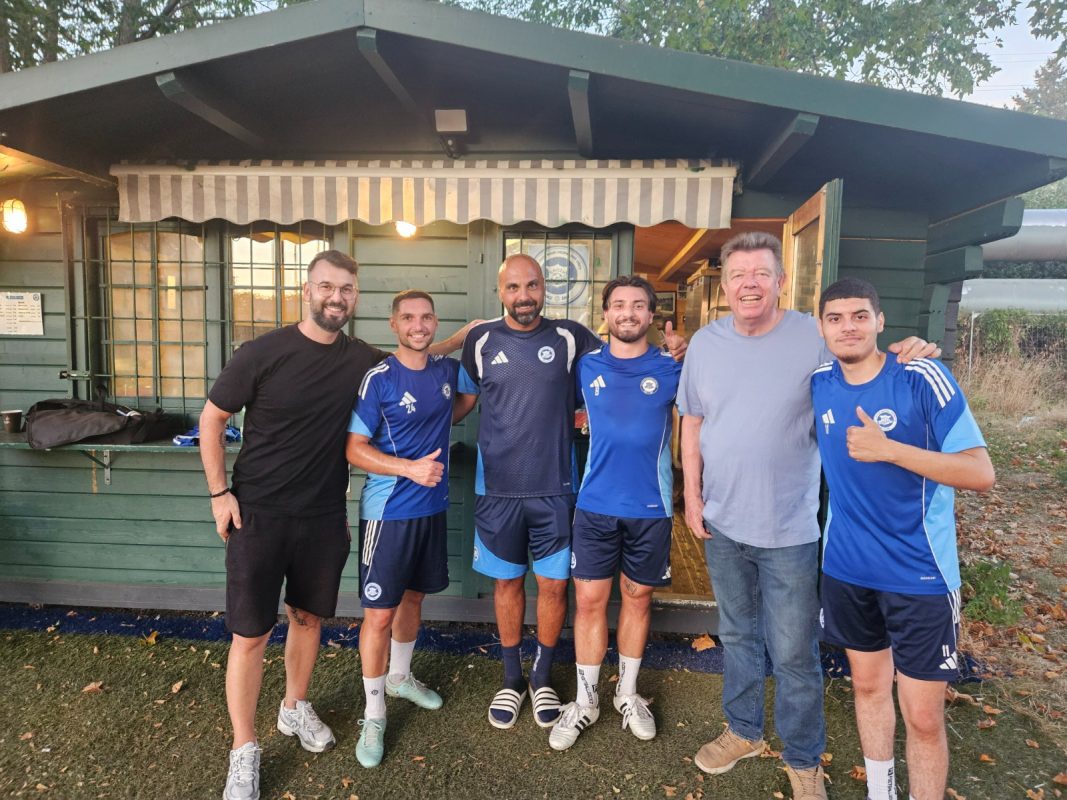
A few days later, I meet the treasurer again, along with other club officials and players, during a training session at the sports complex behind Mannheim’s Carl-Benz Stadium.
At Enosis, social life matters almost as much as soccer.
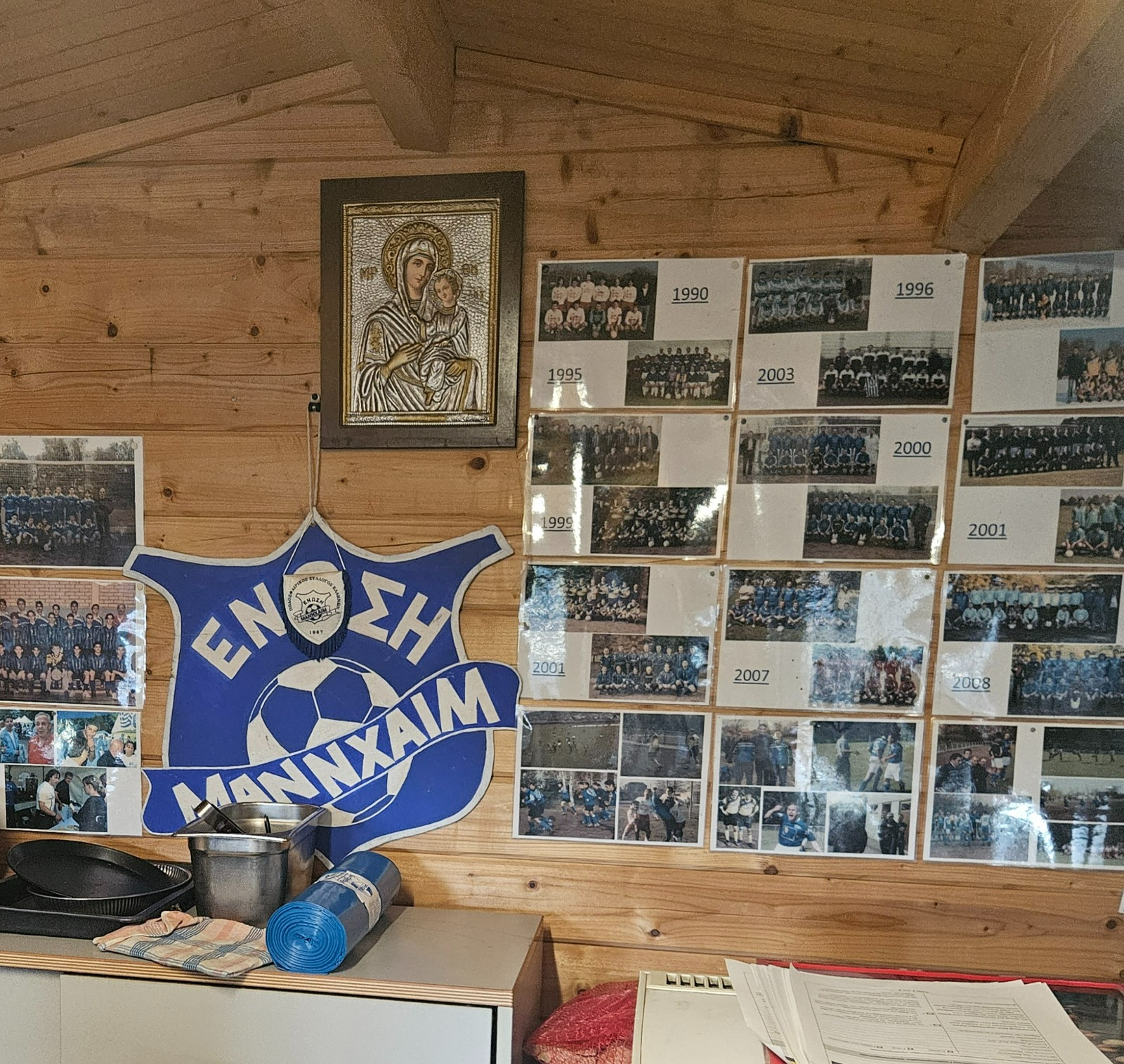
Inside the club’s headquarters, memorabilia commemorating its history line the walls from every year since Enosis’ founding.
Standing behind a grill just a few yards from the field is the club president. There are keftedes, brizoles — Greek-style grilled pork chops — and grilled corn, accompanied by the appropriate assortment of cold drinks, alcoholic and otherwise. And, fittingly enough, a glass of ouzo.
“Hospitality is very important to us. We try to keep our Greek roots alive,” says Dimitrios Georgakopoulos, who played for Enosis for many years and now serves as team manager, handling much of the club’s administrative work.
For him, volunteering at Enosis is a way, as a German-Greek, of giving something back to the “community.”
The way he describes himself is telling. This is no longer the generation of Greek labor migrants. It is a generation at home in two worlds – one that considers Mannheim home just as naturally as it considers its Greek heritage part of its identity.
Then he says something I hear repeatedly around the team and from other Mannheim residents of Greek descent:
“We are all more German here than we are Greek immigrants.”
German is the language spoken around the table most of the time. I get the impression that the Enosis people switch languages mainly for my benefit.
“Many Germans don’t even know that Enosis is a Greek word,” Georgakopoulos says.
The club’s supporters include Greek restaurant owners as well as people with no Greek background at all – currently among them a German businessman in the antiques trade.
A word of perspective is necessary here. SV Enosis Mannheim plays in the Kreisliga, one of the lower tiers of Germany’s vast amateur soccer pyramid. This is a world away from the professional leagues and their multimillion-dollar budgets.
Yet even at this level, I learn, soccer cannot function entirely without money.
“Nobody here is going to become a professional anymore,” Georgakopoulos says. But players can expect a small appearance fee for each game and a bonus for a victory. These days, he says, it is difficult to run a competitive amateur team otherwise.
Last season, this tradition-rich club won the Mannheim district cup. This year, the defending champion was eliminated in the first round. The focus is now entirely on the league, with club officials making no secret of their goal: promotion to the next level.
Enosis today has around 100 members, many of them Greek. Its motto, displayed on social media alongside the club’s blue-and-white logo, reads: “One Club, Many People, One Unity.”
That slogan says a great deal about what Enosis has become.
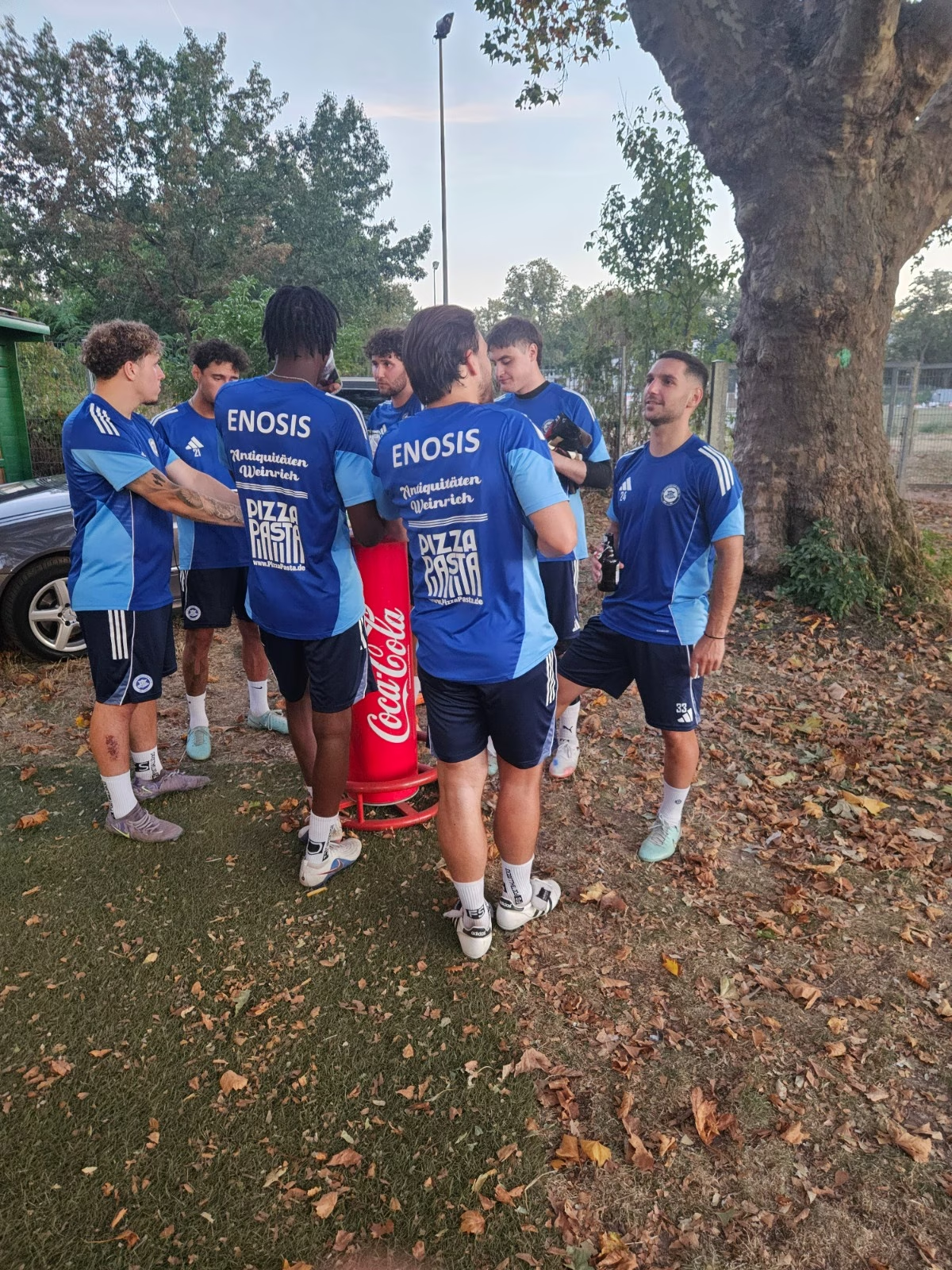
The soccer team in a moment of relaxation.
Today’s squad includes six Greeks alongside players from other immigrant families and Germans without an immigrant background. This, too, tells the story of the club’s transformation.
Founded by Greek immigrants, Enosis is no longer a soccer club primarily for Greeks. The name remains. So do the blue-and-white colors and many of its traditions. But the team itself has come to reflect multicultural Mannheim.
Perhaps this is precisely where the club’s future lies.
Its Greek identity is not disappearing, but its meaning is changing. It is becoming less a matter of where individual members come from and more a tradition that binds them together.
And this is where the story becomes particularly interesting to me. Enosis is more than a soccer club. It is a mirror of Mannheim’s Greek diaspora – perhaps even a kind of living memory book.
Wherever I go during these weeks — to the Greek community, to Greek restaurants, to Greek-owned businesses — I encounter connections to the club. Enosis belongs to Mannheim’s Greeks the way Olympiacos belongs to Piraeus. At least, that is how it seems to me.
To learn more about the wider Greek community, I arrange to meet Archpriest Georgios Basioudis. A theologian with a doctorate, he has headed Mannheim’s Greek Orthodox parish since 2003 and is highly respected throughout the Greek diaspora well beyond the city. More than once, people tell me that the community was extraordinarily fortunate to have him.
Under his leadership, the parish purchased a Catholic church in the northern part of Mannheim and transformed its interior with impressive Orthodox iconography. The church has become an important gathering place for Greeks, particularly members of the older generation.
When Dr. Basioudis receives me one late afternoon in the church garden, he does not complain about declining attendance.
I ask him about the future of Greek life in Mannheim. What will the community – its institutions, associations and clubs – look like ten years from now?
When it comes to Greek-language education, which now exists only in a limited form and without German state involvement, Basioudis is not particularly optimistic. Nor does he see especially bright prospects for the local Pontian Greek association.
When it comes to the future of his own parish, however, the archpriest is confident.
And what about the soccer club, SV Enosis Mannheim?
“That will survive,” he says.
In that case, all that remains is to keep scoring goals.
Dr. Ronald Meinardus is a Senior Research Fellow at the Hellenic Foundation for European and Foreign Policy (ELIAMEP) and a self-declared philhellene who hails from Germany and regularly spends time in his wife’s native Mannheim.